One day a few weeks ago, I was getting ready to make my Giant Breakfast Cookie recipe…but decided to play with it a bit and create some kind of breakfast bar instead. (I LOVE playing with recipes!)
I came up with these yummy apricot bars and knew I’d have to share it with you.
And then I forgot. (So sorry.)
Then, last week, Marie emailed and asked if I’d try to come up with a good breakfast bar recipe (I think she said something about “since you’re so brilliant in the kitchen”…yeah, that was it.). And I was reminded that indeed – I had already come up with one. So Marie (and everyone else), here you go! (I hope you like them, but if you don’t, can we still be friends?) :)
Apricot Breakfast Bars
2 sticks butter
3/4 cup honey
1 teaspoon baking soda
1 teaspoon sea salt
1 teaspoon vanilla
1/2 cup buttermilk
2 eggs
2 cups whole wheat flour
1 1/2 cups rolled oats
1/2 cup unsweetened coconut flakes
1/4 cup sesame seeds
3/4 cup dried apricots
Melt butter and honey together. Remove from heat. Pour mixture into a mixing bowl and add baking soda, salt, vanilla and buttermilk and eggs. Stir in flour, oats, coconut and sesame seeds until well combined. Cut dried apricots into small bites (I usually cut mine into fourths). Fold apricot pieces into dough.
Bake in a 9 x 13 baking pan at 350 degrees for 25 minutes.
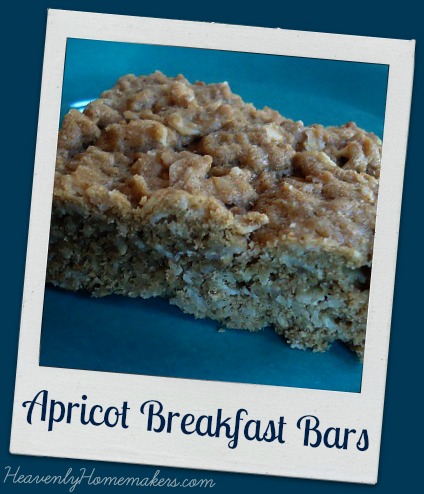
You can play with these yourself and add any combination of fruit and nuts – I know I’ll continue to mix and match different ingredients! Enjoy!

Laura,
These sound delicious! I think I will need to add this to next week’s menu plan. I love that you can incorporate soaking! When I first saw your title, I assumed it would call for apricot jam, but much to my delight, you call for dried apricots! Thanks!
Blessings,
Michele
http://www.frugalgranola.blogspot.com
Oh yum!!!! I can’t wait to try these out when we get home. Thanks Laura.
They sound delicious. Sorry to be a pain, but can you tell me how much is a ‘stick’ of butter? Thanks.
Catherine…you are never a pain!! I LOVE learning the different terms used in Australia for cooking too! A stick of butter equals 1/4 pound, or 1/2 cup. So this recipe calls for 1 cup of butter. What form does your butter come in there?
In Australia and New Zealand we get butter in packages that looks pretty much the same as your sticks do, they are justlarger – in New Zealand you only get in 500grams/1/2 a lb, in Australia you can get it in 250grams/1/4 lb or 500 grams/1/2lb!
These look really good. I’m going to try them this weekend when we have guests coming. Thanks for sharing! Kelly
Yummy!! Hummmm…wonder how these would taste with apples rather than apricots??
I might just share this recipe with my mom who is diabetic…I think she could handle these. :)
Thanks for sharing!
Thanks Laura!
We get our butter in a 250gram rectangular shaped block. So your 2 ‘sticks’ would be the same as our 1 ‘block’.
I’m all set to try this out now.
Hi Laura-my first response on your site…In looking at your dialogue with Aussies I am reminded to tell you that their cups are a little larger than ours, though I have found if I am consistent with the measurements I use (ie all aussie or all US, then it translates okay). By the way, the butter in Australia that I saw was in a 500g. block (a little larger than a pound-it looks like four of our sticks in one block), thus it would be equivalent to 4 sticks of butter, better to measure in cups for my fellow Aussies. There may have been 250g. rectangles of butter but I don’t remember them where we were.
has anyone tried making these gluten free? How about freezing them? that’s my goal.
I do know that these freeze well, but I’m not sure about the gluten free option. Hopefully someone else with experience will pipe in with an answer!
Hi Laura!
I am hoping to make these for breakfast sometime this month, but I was wondering about the soaking part- you specifically mention using buttermilk with live cultures, but I usually make a fake-ish type “buttermilk” using milk and lemon juice mixed together :) Would that work the same soaking magic or not? If not, is there something else I can use when soaking it? I’ll admit that I don’t soak a whole lot of things around here, but it seemed like such a easy step in this recipe so I thought I would try it…I just didn’t know if it would be a complete waste if I didn’t use buttermilk with live cultures.
Thanks!
Amy
Yes, the milk and lemon juice would work as the lemon juice is acidic and would break down the phytates in the grain just like “real” buttermilk would.
Hi Melissa, Australian butter comes in 2 sizes – 250gm and 500 gm. Small or large “block” of butter. The former rectangular, the larger- a square.
Is the coconut for flavor or does it add moisture? We are not coconut fans and I’ll leave it out. Just wondering if I should add something else?
Naw, if you want to leave out the coconut that would be just fine!
I am interested in making these with less fat. Anyone tried cutting the butter in half and doubling the buttermilk?
I haven’t tried it but am guessing double buttermilk would be much
runnier. Maybe yogurt or greek yogurt instead of the butter? Or unsweet
applesauce is a common fat replacement. I am thinking along the
same lines but the first time will probably try half butter and half
coconut oil and later try it with a less fat option.
These look delicious! I just found your website and LOVE it!!! My husband is allergic to casein (protein found in milk) and recently has to be on an anti-inflammation diet (whole wheat everything, and as little processed food as possible). So the family is now on the same diet as well, your website is such a blessing, thank you for all the delicious recipes!! I was curious on these bars, the buttermilk, can I use almond milk with the lemon trick? I usually avoid recipes with buttermilk because I am scared to try to figure out a substitute for it but these just look to yummy!! Thank you for your time!!
Yes, I would sure think that the almond milk/lemon juice combo should work fine!
My husband is also allergic to the protein in milk which means he can also not eat any butter. Unfortunately the only substitue I know of is to use a soy based margarine which I would prefer not to use. Do you know of any other good “healthy” butter alternatives?
Are you wanting it for baking, or for everyday use (i.e. toast)?
We use blue bonnet, it is a soy based margarine. I haven’t found
any alternative on my end for everyday use. In baking I just use
that because in most cases, the casein bakes out enough that it
doesn’t bother him very much (only in the minimal ingredients, where
there isn’t much to begin with.) You can also use other alternatives,
like applesauce when baking. Have you looked in the health food
stores? That is where I get the truly non-dairy cream cheese, sour
cream, yogurt and pudding (these are all however soy based) they may
have an alternative there. There are doing great things with almonds
so maybe they will come out with something soon. Hope this helps.
I’d recommend coconut oil as a healthy, dairy free alternative!
You can use coconut oil, it is wonderful to bake with. Adds a lot of moisture.
I would recommend the coconut oil too for baking! But if you’re
wanting other uses I would look into goat’s milk. I know many people
who can’t tolerate cows milk who can easily use goat milk
products.
I will have to try the coconut oil, does it leave much of a coconut taste?
Goat’s milk won’t work either, the protein my husband is allergic to is in
the grass that cows and goats eat. So casein is also found in goat’s milk.
Amanda, there are two main types of coconut oil. There is the not
as expensive expeller pressed – which does not have the coconut
smell or flavor. This can be used in anything. Then there is the
most expensive (I think centrifuged maybe? not expeller anyway)
that does have both the scent and flavor of coconut. I keep both,
depending on the recipe!
I never knew the casein was in the grass…
Kori
Thanks Kori, I will have to try those, they sound like they will work
fine. Yea, casein is pretty nasty stuff…at least for my husband. :)
Palm shortening is another alternative to baking with butter and I find items I use it with hold their shape better than coconut oil. I’ve also used half palm shortening and half coconut oil successfully in recipes that call for butter, like scones.
Wow. I am surprised that you use any margarine at all Its making me rethink the margarine thing, We use only real butter but it gets really expensive with 5 kids in the house. I do have a question about the recipe. Do you HAVE to use buttermilk or can 2% milk and a little vinegar work?? I’m just curious because of the live cultures. Thanks for this post I am really in a snack rut and Its the first day of summer break so the timing is perfect! =)
I don’t use margarine at all – the above comments weren’t mine! I’m pretty opposed to margarine of any kind. As far as buttermilk goes, you can sub milk and vinegar no problem!
Oh ok that explains it! I’ll look better next time! Thanks!
I just made these with my Bob’s Red Mill All-purpose Baking flour and a 1/2 teaspoon xanthan gum. Instead of a full cup of butter, I used a 1/2 cup butter, 1/2 cup applesauce. I also added a teaspoon of cinnamon, about 1/4 cup flax seed meal and granola on top. I omitted the coconut and sesame seeds because I didn’t have any on hand. It turned out a little cakier than I thought it would be for a “breakfast bar”, but it was very delicious! Would be equally yummy with dried (or even fresh) apples. Thanks Laura!
Thanks Tara, I was just looking at these & you saved me a trip to the Bob’s Red Mill website:)
My apricot tree is overflowing with apricots. Will fresh apricots be ok? I’m a rookie at baking, but these sound great!
Sure, fresh apricots sounds great – I’m jealous!
I just made these. They came out as a cake rather than a bar? Do you think I did something wrong or
Our definitions of a bar are different? :) They look pretty and taste ok, I guess wheat flour take time to get used to the flavor?
Hmmm, I guess they do seem like a cake, but a thin cake that I cut into bar sized pieces. So, maybe we’re talking about the same things. And yes, it does take some time to get used to wheat flour. I use freshly ground wheat flour, which might make a difference in this recipe.
Thanks for your reply! So I made them right. My neighbor enjoyed them and she Bakes a lot with wheat. They are gone now, so i think i need to make more. If you were around where I live I would gladly share my apricots! I’m jealous of your freshly ground wheat flour! Now we are even on the jealousy. Haha
Mmm, I have these soaking for tomorrow. My 2 year old loved helping by breaking the apricot pieces into “little pieces”. Thanks for all your great recipes!
Yummy!! I am going to make these for breakfast this week. Maybe I’ll add some chopped dates too…. LOVE apricots and dates together! Thanks Laura!
Can you soak with milk kefir instead of buttermilk? I have so much kefir and i have no idea what to do with it! would you use t#he same amount?
Yep, just substitute it in the same amount!
Could I substitute canned apricots for the dried ones? That’s all I have right now and I’m itching to try this recipe out! I can always wait if you think it won’t turn out very good :)
I think it should work okay, as long as they aren’t too juicy.
Yummy! We just enojyed this today. I did soak it last night. My kids, who cringe at anything new, weren’t excited. But they all ate seconds. They said they would want thirds but were way full before their seconds were gone! So we have enough for another day too.
I added coconut oil (in addition to all butter), coconut spread (pureed coconut since I have one that doesn’t like flakes of coconut), wheat germ, ground flax seed, cinnamon and instead of apricots I shredded two granny smith apples! I also sprinkled the top with cinnamon sugar and added some leftover strudel topping I had on hand. So it was much more like dessert than breakfast… But it was a hit! It did have to cook much longer but I added a LOT to it.
I also think the soaking makes it more cake-like than bar like, while not soaking makes it more bar like. This is just a guess but I see posts asking about it. Everytime I soak my whole wheat it makes it act like white flour and it’s totally light and fluffy. I am not convinced of soaking for phytates, but love that it makes my food look and feel like white flour with nutrients of whole wheat!
THanks for the great recipe. I can’t wait to try it with other fruits. My kids were asking for a blackberry version, which it’s blackberry time here right now!
OOH! These are yummy. I bought apricots just to make these bars and am so glad I did. I used coconut oil instead of butter and keifr for the buttermilk. These are going on my regular rotation!
I have made these 1/2 dozen times since I found the receipe on your site – they are amazing!!! I didn’t have buttermilk added youget once, applesauce another time, never used the coconut/sesame seeds, added dates once, craisins and choc chips once…point being they are yummy and you can’t mess them up :-)
These are in the oven right now. I can’t wait ’til they’re done!
SO delicious! I wish I had read Kori’s comment, though, and added some flax seed and cinnamon. That sounds yummy! Quick question — when you make yours, do you use raw or toasted sesame seeds?
I just use raw.
I’m trying to get into baking with whole wheat. This was my second attempt (my first didn’t go well), I used dried apples and whole wheat pastry flour. The bars were good but very dry and crumbly. We will have to eat them with a spoon. What did I do wrong? Is whole wheat pastry flour much different from whole wheat flour? I’m also wanting to try your honey whole wheat bread (and cinnamon swirl), but my experimenting is getting costly. Any advice would be appreciated.
I’m thinking the problem is the dried apples. They plumped up quite a bit in the finished product. I think maybe they absorbed alot of the moisture (and I probably put too many in).
Yes, that makes sense. To answer your question about different wheat flours, here’s a post I wrote to explain: https://www.heavenlyhomemakers.com/what-kind-of-wheat-flour-is-best
Hi Laura,
I’ve had so much fun recreating and adaping your recipes but I had a question about this one that I’d appreciate an answer to if you could find the time. I noticed this recipe called for buttermilk with live cultures. So far I’ve been substituting all milk for coconut milk and all butter for coconut oil due to a dairy allergy. What do you think I should do to adapt this? Also, my kids love apples to an extreme degree. Do you think this would work as well with fresh or dried apple slices and a bit of cinnamon perhaps?
Thanks!
Kim
Kim, You can add a few teaspoons of lemon juice to your coconut milk and let it sit for a bit to substitute it for the buttermilk. You may also vinegar instead of the lemon juice.
Sorry, I should have scrolled through the above comments first. Thanks for creating such a fabulous site!
I made these today using apples, diced very small, a little cinnamon and sunflower seeds (becuase my kids love them). They turned out great! They were a little more cakey than I expected and mine seemed to have risen more than yours. Maybe it was the baking soda (or maybe becuase I didn’t soak mine, which I’d like to try next time). I have a pumpkin bar recipe that I use that has no levening that I love the texture of so I may skip the b.soda next time and see how they turn out. I’d like to try cranberries and pecans! They are one of my favorite Christmas combos! Great recipe to have and change up and very easy to put together.
I am making these tomorrow. I might be the only one in the house who eats them, but hopefully they will freeze well. When I was a little girl, a million years ago, I always got a box of dried apricots in my Christmas stocking. I think a box cost $1.99 and it was quite a splurge. I still always get apricots for myself at Christmas….good memories, but I’m always just eating them plain….these sound so good. Thank you so much.
These are yummy! Thanks for the recipe. :-)
What advice do you have on freezing these bars? Specific instructions are greatly appreciated! Also, for those of you that subbed coconut oil – how much did you use? Thanks!!
I’d allow them to cool, cut them, then wrap them individually in plastic. Then I’d put them into a freezer bag for the freezer. You can sub coconut oil one for one with the butter.