Wanna know how EASY it is to make cultured buttermilk, kefir and sour cream? Yeah, it takes about 30 seconds of your time. (Don’t tell anyone that though…they think it’s impressive when you make your own.) :)
The beauty of making your own cultured dairy products is that once you make one batch, you can save the last cup or two to start a new batch. It saves a lot of money to do this, and it is so easy!
I buy my buttermilk, kefir, and sour cream (also known as kreme fresh) starter online. Here are some great starter packet options:
- Buttermilk and Sour Cream Starter Culture (yep, you can use the same one for both products)
- Kefir Starter Culture
To Make Kefir:
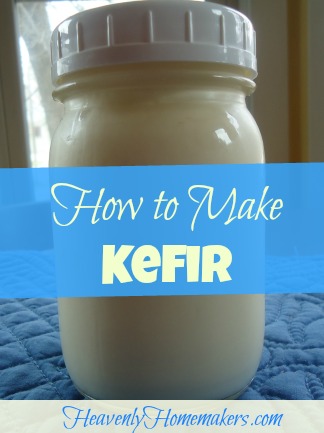
I begin with just under a half gallon of raw milk in a glass jar. (You can make this with pasturized milk too as far as I know.) I pour the packet of kefir starter into the milk, shake it up, and put a lid on it. Then, I set the jar in the cabinet above my refrigerator for about 24 hours (in the winter, it takes a little longer in my COLD kitchen!). You’ll know it is done “culturing” when it is thick and has some bubbly looking bubbles all through it. And when you tip your jar over, it kind of…glops. (see how helpful I am?)
To Make Buttermilk:
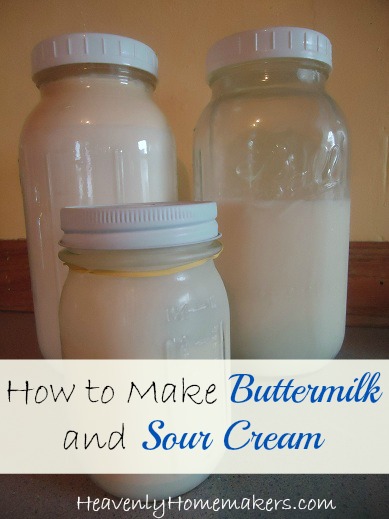
Follow the same instructions as for the Kefir, only use the Buttermilk Culture Starter.
To Make Sour Cream (aka kreme fresh):
Use the Buttermilk Culture Starter with one pint of cream. Follow the same directions as above.
Now, to make more batches of each of these…
Save about a cup each of kefir or buttermilk (or about a third cup of sour cream) from your initial batch.
Use this remaining kefir, buttermilk or sour cream to shake into more raw milk or cream (1/2 gallon of milk…or 1 pint of cream) to begin a fresh batch. Just put it in, shake it up, and let it sit out for 24 hours or so. (Until you’ve got the glop thing going on.) You can do this up to eight times before you need to begin with a new starter package. (I’ve continued it more than eight times when I’m feeling rebellious. It still works.)
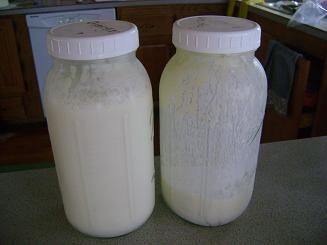
Here’s the tail end of one jar of buttermilk,
ready to be poured into a fresh 1/2 gallon jar of milk.
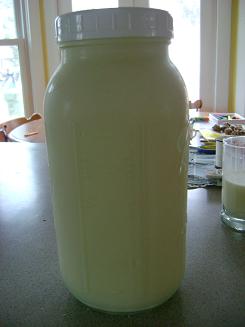
Here’s a jar of milk with a cup of buttermilk shaken into it,
ready to begin the culturing process.
(Yes, I know it looks like a plain ol’ jar of milk.
You’ll have to humor me and act like you can tell .
Nod and say, oh…very nice.)
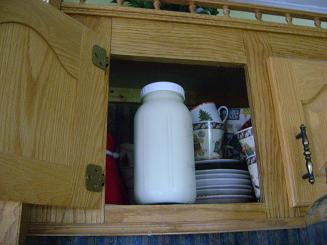
And here is my milk turning into buttermilk in the cabinet above my fridge. (With my Chrismas dishes.)
I’ve been advised that this spot is the best one in my kitchen to culture things because it has a fairly consistent temperature.
Oh, and when I do put my culturing dairy products in this cabinet, I LEAVE THE CABINET DOOR OPEN so that I can see it. It’s a bad idea to forget you have buttermilk or kefir or sour cream culturing in a cabinet. A bad, bad idea.
Now you have really, really healthy kefir for smoothies, and really, really healthy sour cream for your tacos, etc, and really, really healthy buttermilk for drinking or for making Creamy Orange Cooler.
See how easy it is?! :)

A more frugal route is using kefir grains for kefir. It is just as easy and you can find free kefir grains online here.
They reproduce themselves too so you should never have to get them again.
I wrote about how to make it yourself here, if any one is interested.
God bless,
Lindsay
HI LINDSAY,
I’M INTERESTED…AND WOULD LIKE SOME GRAINS….!
BEST REGARDS,
JAN
You can get some kefir grains by following this link: http://www.amazon.com/gp/product/B000ZTG4UG?ie=UTF8&tag=wwwheavenlyho-20&linkCode=xm2&camp=1789&creativeASIN=B000ZTG4UG
Thank you so much for posting this! I’ve been wanting to try making my own kefir…hopefully I can try it soon! :-)
That sounds super easy. I will have to give it a try. Do you know how long the buttermilk, kefir, and sour cream keep in the fridge after you’ve made them?
Thanks for the info!
Where do you get your jars?
I’m excited about the sour cream. My husband and I eat a lot of it. I would imagine that it’s not very thick made this way? I wonder if it tastes like the Russian variety we enjoyed so much while over seas.
Although I haven’t tried these three things, I have made yogurt using a bit of already made yogurt as a starter. I used my crockpot filled with warm water to hold the jars of yogurt during the incubation time. Yogurt is a lot more touchy than some other things though.
I also made cream cheese two different ways. On one batch I used a tiny bit of rennet, but the cheese became too firm and wasn’t very spreadable. The other way was leaving the raw milk out for three days, carefully covered. Then I strained it through a towel for another day or so until all the whey was out of it. What amazed me was that the cream cheese was sweet and all the sour stayed in the whey! It was the perfect consistancy too. I felt like such the domestic diva! ;)
Thanks for these suggestions and resources. A gallon of milk a week is usually too much for my husband and I, and it would be good to know what to do with the extra.
Thanks so much for posting this…I’ve been buying my kefir and it’s so expensive! :)
What other products do you recommend getting from Wilderness Naturals if one doesn’t have access to Azure or another food coop. I Love your blog. Thanks for all the wonderful information!
We have also started to make our own yogurt. We love being able to make our own dairy products.
Thank you for all that you have taught me over the past year. I have grown so much and I have you to thank.
Wow! What a wonderful idea! I never knew that could be made at home!
A friend of mine told me that kefir was so healthy for us to eat, but I never found a way to squeeze it into our diets (she did recommend kefir in smoothies, now that my brain gears are working.)
I do wonder what another commenter had pondered, and that is how thick the sour cream gets.
You have a lovely blog, by the way! I loved your ideas on homeschooling!
What exactly is kefir? My mother called and asked me this yesterday…. I have never heard of it… I have also been wanting to ask you a question about rapadora.. do you exchange it in equal amounts for recipes that call for white sugar… Thanks Erika
I have to repeat the question asked in another comment: Where DO you get your lovely jars (I love jars!)
Wow thank you, i’m learning from your website. Well there is other website that i very recommend, check it out:
http://www.howtomakekefir.com
You can get some eally pretty, inexpensive jars at Walmart and Garden Ridge. If there is no Garden Ridge near you, any home furnishing specialty store should have an imaginitive collection of glass jars.
And now, a question. What happens if I put the kefir grains into buttermilk? What about a combination of milk and buttermilk ? Since I started playing with the grains, my kitchen has turned into more of a lab. In honor of Frank Zappa, we call it the Utility Muffin Research Kitchen. I feel like a kid again, with kefir science projects everywhere.
I just found this thread about Kefir. I made my first batch day before yesterday (only a Qt.) and I’m already culturing my second! I have been making smoothies with fresh berries – strawberry and/or blueberry and since I’m on a no sugar diet, I add a bit of stevia to slightly sweeten! They are awesome.
I have a question about the many uses of kefir. Basically, it seems that you could use it in any fashion you would buttermilk. Is that reasonable?
started kefir after a friend gave me some to try. fell in love with it ever since. : )
glad to see kefir is gaining popularity now a days. i’ve found this site to have lots of recipes and info about kefir and kefir grains, yogurt too. http://www.yourkefirsource.com
just might want to check it out!
Can you start your own batch of buttermilk using a cup of store bought buttermilk?
Yes, I believe you can. It’s worth a try anyway!
You actually can use as little as 2 Tablespoons of buttermilk to make one quart. I usually use 1/4 cup of Buttermilk in the bottom of a clean quart canning jar and fill it up with fresh raw milk. It works really well and it keeps in the refrigerator for quite a long time, I mean like weeks or even more than a month. It will begin to separate, so I shake it when I want to use it. When it separates it doesn’t seem to effect the recipe I’m using it in, not even ranch dressing.
About how long do you think these things are good for (in the fridge, of course). I want to have these on hand for soaking grains, making cheese, mixing in smoothies or whatever, but I don’ want to “waste” my milk by doing something that will cause my milk to go bad while I am not using it. Any general rule of thumb (since we aren’t dealing with expiration dates)? Thank you!
I’ve had mine in the fridge as long as a month before and it’s done just fine!
Thanks so much! I think I’ll make some Kefir today!
I am curious about the keep time as well. We usually drink our raw milk within 2 days of getting it, but our conventional buttermilk sits in our fridge a bit longer than that. Also, what is the difference between the two kefir starters as one seems to be regular and the other talks about being for drinking…is it just a one time use?
I’ve had mine in the fridge as long as a month before and it’s done just fine!
As far as kefir goes, I use it for both soaking and drinking.
Wow, kefir is so easy. I really may try this.
I’ve always made my buttermilk by pouring a bit of cultured buttermilk into my mason jar and filling the rest of the jar with milk and allowing it to sit out for 24 hours. I’ve never used a vege culture starter. Do you know if what I’ve been doing is not really buttermilk? As soon as my jar is mostly empty, I just add more milk and set it out again (usually at least once a week). It thickens up and seems to have that buttermilk smell/taste. Just curious.
I’ve also just ordered some kefir starter cultures so I can start making my own kefir. Yeah!
No, that’s just FINE what you’ve been doing. That’s what I do too, once I’ve used the culture starter to make the first batch!
Hmmm, I would like to try this!
I am confused on how to make the Buttermilk. I use only milk and rennet to make buttermilk? Please get back with me as soon as you could. I really would like to make this right away!
No rennet, just the packet of buttermilk starter (which is cultured veggie starter). Since you already put the rennet in, I THINK it will be okay. I HOPE it will!!
Okay, I am confused now. I put some raw milk and rennet into a canning jar. I did not realize that the rennet was different then the starter! What are my options? I don’t want to waste the milk! [email protected]
Hi Laura,
I’ve been attempting homemade buttermilk. I had
store bought cultured whole buttermilk. I added
2 quarts of milk to 1 cup of buttermilk starter and have
left it out for 24 hours, it is starting to smell like
buttermilk, but it’s not thick. Should I leave it out
until it gets thick and just keep a check on it? Do I need
to put it in a warmer area, like my oven with the light on?
Any thoughts would be helpful. Thanks.
Sorry I’m so delayed in replying. (Did it turn into buttermilk after all this time?!) :)
Yes, if it hasn’t thickened in 24 hours time, it just needs a little bit more time. During the colder months, I have to leave it out for a day and a half or even longer before it’s done.
Have you looked into CulturesforHealth.com? You can get a buttermilk starter there that you NEVER have to buy again. Just save some from one batch and make some more every 7 days. They have a mesophilic yogurt culture (room temp) that you do the same with. I’m saving my money and going in with a friend to get going on those!!!
Yes, they are a great source! I’m hoping to look at their site more very soon and share it with everyone here at HHM!
Some comments:
Without Kefir grains, you cannot keep making kefir from former batches. It will eventually lose potency. You’d have to either buy the powdered starter again after a batch or two; or get the kefir grains. They grow and you will have to share them eventually. Go to Dom’s kefir site to get the best information about making kefir. It’s an ancient custom and you should really learn the right way so it can be healthy and tasty.You should not use ultra pasteurized milk and organic would be best.
My friend’s mother from Poland said to make sour cream, you can just take three tablespoons of
pure commercial sour cream – mix it into about 8 ounces of good milk (fat content up to you and I would suggest not using lactose free nor ultra pasturized) – and within 24 hours, the whole glass is sour cream. It probably gets thicker the more you leave it on the counter, but I don’t leave it for more than 24 hours. Sometimes even 12 hours or between 12 and 24 works depending on your conditions. (heat.)
For both, no need to boil milk. I also just started making my own Caspian Sea Yogurt which I bought a starter for (live culture) and it doesn’t have to be heated like the yogurt we make here. Just add the starter to about 2 cups of milk and voila – yogurt within 24 hours.
I’m still working on the timing and flavor and there are a lot of sites that explain the how to and how not to. Good luck! It’s great for your digestion.
Hi Diane,
I’m excited to read about the sour cream recipe you posted…have you tried it??
Also, can you use 3T of that sour cream to make another batch & so on??
Thank you so much!!!
Tiffany
This morning I made butter & I have yogurt “processing” right now…my husband asked about sour cream this morning as I was making the other. He’ll be happy as well!!
blessings!
P.S.
http://users.sa.chariot.net.au/~dna/kefirpage.html
For Dom’s kefir site.
Have a great Thanksgiving!
I have a quick question or two. I would like to make kefir with both the raw goat milk and cow milk I buy from week to week. I ordered the kefir grains you recommended. When you wrote about making batches using leftovers from the last batch, how old can the last batch be? Is there a limit to how old you can let your old kefir get before using it to start a new batch? Also, can you use your old goat kefir to start a cow milk kefir batch, or are those best kept separate from eachother?
Thanks in advance! I love your blog and am so thankful for a friend who recommended it to me!
You actually use the kefir grains over and over to make a fresh batch (I’ve learned some of this since posting originally and should probably go edit my post to explain better). It’s okay to use your old batch of kefir to make a new batch with fresh milk, even if the kefir is several weeks old. I’ve never used goats milk but I would imagine you could put the goat kefir with cows milk??
Hi Laura
Would you please recommend a source where I can research raw milk, in regard to safety? Thank you.
Realmilk.com is a great source!
Check out realmilk.com
I was looking into the veggie culture starter for buttermilk/sour cream/butter (from the Wilderness website listed)… So if using the starter in heavy cream will produce sour cream… and you can churn/mix it to produce 1/2# butter and 1 cup buttermilk… Can that 1 cup buttermilk then be used in 1/2 gallon milk to make more buttermilk, or would a new starter be needed? Thanks for your advice!
I am really digging your website! Even though I haven’t acted on your words of wisdom yet, I feel very domestic just reading them!! :) I’m undertaking a lot of change in my life, first starting with healthy living. Hoping to be digging up some potatoes from a trash can next summer! :)
I THINK a regular buttermilk starter would be needed to begin the buttermilk, as the “buttermilk” that comes off the butter making process is a little bit different that the buttermilk we’re used to cooking with.
Did that answer the question correctly, or am I misunderstanding?! :)
Ok, so if I purchase Keifer grains from amazon I use them to grow a plant? Is that a stupid question?
No, kefir grains are super weird. :) You put them into your milk and after 24 hours or so, your milk turns to kefir. You strain out your kefir grains and store them in the fridge (in a tiny bit of milk), then reuse them to make more kefir. The grains reproduce on their own.
Hello,
I made the buttermilk here but had a question as to why mine came out really really thick… maybe you could help!
thanks~
Mine is always quite a bit thicker than store bought buttermilk. I’m guessing you didn’t do anything wrong, I bet it’s just right!
thanks! that’s encouraging to hear! i was concerned it was incorrect :)
Thanks for your quick reply! I do wish I could just chat
with you a bit in person as I have so many questions!
I do have my flour and milk with vinegar soaking now (for
your pancake recipe in the morning); however, I may just
add some lemon juice to it, too, in case the vingar in the
milk doesn’t produce “cultured buttermilk”. Would one
TB of the lemon juice work to break down the phytates?
Also, would regular kiefer or water kiefer work to do this
same thing instead of the buttermilk? And, how much would
I use (1 TB?) Hmmmmmmm
By the way, I’ve been a bit overwhelmed by some other
“healthy websites” that I’ve found as they’ve seemed really
out of my league; however, yours seems “do able” & I
appreciate your basic recipes, too. Thanks again for
helping this mom out who was in a RUT & is trying to learn
to do things the “healthy way”!! I’m encouraged,too, as my
family LOVES your recipes so I’m telling more people about
you!! ;o)
Blessings!
Amy
Thank you so much for your encouragement about my site!!! What you described is exactly what I try to do!
Yes, I think one Tablespoon is great to add. Or regular Kefit (I’d just substitute it one for one with buttermilk, or maybe add 1/2 cup at least, and then the rest regular milk. Just enough to add something cultured.
I don’t have experience with water kefir, that’s on my list of things to try!
Okay, my family thinks I’m going a little overboard, but
I currently have my beans soaking (with lemon juice) for the
first time ever (I always just used canned beans before), &
I have your pancake batter soaking, along with some organic
wheat flour (in lemon juice)! My 5 yr. old daughter keeps
asking: “Mommy, what ARE you doing?” As soon as I know,
I’ll begin to teach her!! ‘o) Anyway, I don’t have a
grainmill as of yet, but after being inspired by YOU,
it’s on my “wishlist” for our 20th anniversary coming up! ;o)
So, in the meantime, I’m buying some local, organic
whole, white wheat flour from our healthfood store here. I was
told that the white/wheat combo is as healthy as the whole
wheat, would you agree? And, if I’m just using regular
white flour from the store (for baking), would I be able
to break down the phytates by soaking them as well (even
though the nutritional value is way less, I know). My
family just isn’t used to the taste of whole wheat yet
for cookies(I’m hoping that a Nutrimill would make the
flour more fine, not so grainy, & that they’ll like it better
then). However, I realize that I need to make these changes
slowly (especially since our 2 boys, ages 13 & 16) sometimes
frown on my “healthy baking” as they’re so used to the
other. sigh
Also, switching gears………..in response to my
last question tonight about using lemon juice vs. buttermilk
to break down phytates in flours/beans………..I’m
a bit confused as to what is best: the lemon juice from
concentrate says that it has 2 different preservatives
added(ahhhhhh….I’m trying to stay away from those!) However,
the little lemon squirt bottle lists water as it’s first
ingre. & then has lemon juice (not from concentrate) listed
2nd, as only 30% though. It also has lemon oil. It’s all
organic, but out of date (has been sitting in the little
PLASTIC bottle all this time. ;o( Soooooo, what would
you recommend that I do? Since the white vinegar and milk might not make “cultured buttermilk”, I feel that this other
route is better, but is the little lemon squirt bottle
enough “acid” at only 30% lemon juice to break down those
phytates? And, my bread recipe calls for water, sooooooo
I was hoping that the water would do (along with the lemon
juice)vs. using buttermilk in creating these benefits. It’s
the acid content that breaks them down, right? Sorry for the rambling!! I promise and I won’t “hound you” with anymore questions, tonight, at least!! ;o) Thanks again for your
patience!!!
Oh wow, I’m shocked that the lemon juice has preservatives. GRR. I’ll have to go look at my bottle to see what it says!!
Yes, it’s the acid content that breaks down the phytates…I’d use water with lemon juice for your bread.
And I’d just use whichever lemon juice is the lesser of the evils! :) TOUGH decision! Maybe look into making buttermilk with a culture starter soon if possible? I’ll be doing a post explaining more about this soon(ish).
Santa Cruz makes organic lemon juice and organic lime juice. Should be at a HFS or regular grocery with an organic section. If not, why not just buy real organic lemons??? They can be frozen. Just let them thaw on the counter a little bit before using, poke a hole in the bottom and squeeze, or when you first buy them, squeeze the juice out and freeze it in ice cube trays. I prefer real organic lemons to the purchased juice.
It’s been my experience, after 35+ years of kitchening that most homemade buttermilks are not thick. Sometimes it thickens up a little after being in the fridge, but not always. The consistency will always be different. The way to make cultured buttermilk is to take whole raw cow milk and add a couple of TBSP of store-purchased cultured buttermilk and leave it on the kitchen counter in a warm spot, for about 12-24 hours. You can leave it longer if it doesn’t seem soured enough. A lot of the “culturing” part will depend on the temperature in your kitchen.
Also, goat milk and cow milk should NOT be interchanged in kefir and yogurt, etc. They contain different enzymes and therefore will produce two different products. If they are mixed, it will create something weird because goat milk is naturally homogenized.
OMg wow I am completely lost. Lol I dont even know what Kefir is. And what would i need to use it for..And if i dont have the means to make my own buttermilk yet (hubby getting on me cause we have small apartment for the 3 of us) Is there any cultured buttermilk i can buy??
Kefir is similar to yogurt…but runnier (more like a drinkable yogurt). And yes, most buttermilks you can buy are cultured…the carton should say if it is or not.
Hi Laura! I don’t know if anyone mentioned trying http://www.craigslist.com for kefir grains, but thought I would just in case. I was able to get some free, fresh and locally.
Your enthusiasm about kefir has sparked mine and I’m excited to try. God bless!
Question: My kefir grains refuse to “grow”. Suggestions on what I might do to make that happen??
I had trouble getting my kefir grains to grow once too. They still make my milk turn to kefir, but they never grew…weird! Finally they quit working at all and now I’m starting over with new grains!
Yeah, mine still make kefir, too, but I’m afraid the same thing will happen to mine as what happened to yours — they’ll quit working altogether! Well, if I hafta buy new grains that’s all right but I don’t want the same thing to happen to them. I wonder if it was something I did wrong or if it’s just the quality of the grains I bought? I bought from a reputible seller (Happy Herbalist). Oh well, I guess I’ll just keep going with the little bit I have and see what happens. I usually make small batches anyway, so it might turn out to be okay after all.
Thanks for responding!
I buy more raw milk than we can consume in a week. Can I make good kefir out of raw milk that has started to turn bad? And if so, can it be done when the milk is really bad tasting or just when it’s on the edge of turning?
Thanks!
Susan
If it’s already smelling/tasting bad, it won’t work for good tasting kefir. If it’s just slightly souring, it should be okay.
Laura…Do you use the direct-set culture or the starter cuHealth. They say that you cannot reculture the milk made from the direct-set, but the starter culture can be recultured indefinately. You said you reculture yours only 8 times, so I’m not sure which one you use. I think if the direct-set can only make 8 small batches, the $6 + $4 s/h is way too costly, but they say there are extra steps involved for using raw milk with the starter culture. Also, do you skim the cream off yours before culturing? Last question (I promise)….is it better to use fresh raw milk, or is it ok to use week-old milk? Many thanks in advance and God bless.
I had been using the one you can only re-use 8 times…but since there’s a starter that can be used indefinately, I’ll go with that one next time for sure! I leave the cream on my milk before culturing. Sometimes I shake in the cultured cream…sometimes I skim it off and use it for “sour cream”. It’s fine to use the milk that’s already a week old.
If you purchase cultures from Cultures for Health, be sure to use the coupon code: HH2011 for a Heavenly Homemakers 10% discount!!
My dehydrated sugar water kefir grains revived very well and are growing nicely. My dehydrated milk kefir grains were puny from the start. They only rehydrated to about half a teaspoon and were making a pint of yogurt every 12 hours. Yes, yogurt. I used to make yogurt 30 years ago, and I know the taste and consistency very well. We have had no yogurt in the house for years, so the problem had to have been with the culture. Either it was contaminated at the producer, or it was so feeble that spores floating around in the kitchen, possibly from my sourdough culture, overwhelmed it. Either way, it wasn’t making kefir.
I kept searching the Internet for a solution to my problem and finally found a place that sells active cultures in the USA. I ordered some active milk kefir from them, and what a difference! The second day under milk, one tablespoon of active culture has made one cup of yeasty and slightly sour beverage in 24 hours just as promised. The active culture itself smells yeasty and slightly sour. The rehydrated dried one that was making yogurt smelled slightly cheesy. The active culture from Yemoos cost the same as the dehydrated that I bought elsewhere and is much, much better.
So, anyone in the USA having trouble getting dehydrated kefir cultures to revive and work properly, as I did with some dehydrated milk kefir grains, should try ordering an active culture from Yemoos at http://www.yemoos.com/index.html . The cultures each come with cute little adoption certificates, too.
Re-reading the above, I see that I did not make it clear that the active cultures are grains. They are grains, just not dried ones. They are awake and are shipped by Priority Mail every Tuesday, in a little milk (or whatever medium is appropriate for the type of grains). The grains are sealed in a sturdy plastic pouch, which is well-wrapped in some light foil paper, and then sealed in a second plastic pouch along with their adoption certificates which show the date they were sent. There seems little chance for leakage during transit.
I ordered buttermilk and kefir water cultures from Cultures for Health!! Thanks for the discount!! When I was reading about starting the buttermilk with raw milk, it says you need to heat the raw milk…is this something you do? I was a little confused about the directions. Thanks!! I absolutely love your website!!
No, I just use it fresh and cold. I’m lazy about it, plus I want to keep it raw. It works for me!
One more thing…I did purchase the heirloom buttermilk culture. Is this the one you started with as well? Thanks!!
Yes, that’s the one I use!
Hi…I do not mean to bother you again about the buttermilk starter, but I am a little confused. I am trying to follow your directions, but when I read the directions that came with my culture, it has a special section for “raw milk”. I noticed you said you could use it up to 8 times, but if you look on the Cultures for Health website there are 2 buttermilk starters…one is buttermilk/sour cream direct set which you can use up to 8 times and the other is an heirloom buttermilk culture which can be perpetuated over and over. There is a difference in price for these cultures. I purchased the heirloom for $11.99. I believe the other is $5.99. It says in the directions if you do not heat the milk, it will eventually ruin the culture and it won’t be able to perpetuate. I would rather not have to heat it, but I guess I will have to. I didn’t know if anyone else had this question. Again…Thanks!!
Oh wow…this would be me not reading the fine print. I guess the one I’ve been using is NOT the heirloom. Maybe next time I’ll get the heirloom so I don’t have to purchase over and over (although I’ve found that I can make more than 8 batches and it comes out fine.)
Thank you for sharing these recipes with us cannot wait to try them. I see you have plastic lids on your jars in the picture, do I have to use a plastic lid? Where do you even buy them at?(plastic lids for mason jars)
I can usually find them at Walmart in the canning section during gardening season!
But no, you don’t have to use a plastic lid. I just like them better for things like this!
I have found that the plastic lids on small peanut buttef jars fit a typical small mouth canning jar well. I’ve been saving and washing mine.
Hi, I have a couple of questions about the kefir. I read on another site that it can be up to 2% alcohol. Is that safe to give to my kiddos? I’m totally clueless so I hope that isn’t a dumb question. I can just see us showing up to church with drunk kids and getting CPS called on the weird homeschoolers lol!
I am getting my kefir grains tomorrow from someone who has been culturing them and is sharing with me. Do you know if I can use them in regular, store-bought milk? Just skim milk? Raw milk is pretty expensive around here, but I guess I could buy a gallon of organic every now and then if I needed too. It’s just really hard for me to justify that expense.
Also, besides smoothies, what else do you use kefir for? Those of you who drink it, do you just drink it plain?
Oh wow…I’ve never heard that. It must be because it’s fermented milk – that’s what kefir is…the culturing actually is a fermentation process. I don’t think you have to worry about getting your kids drunk!!
Yes, you can use them in regular store-bought milk. I would suggest whole milk instead of skim or the kefir will be pretty thin.
I really just use it to make smoothies. Sometimes I drink it plain, but I don’t really prefer it that way!
When baking with cultured buttermilk or yogurt, are the cultures destroyed? Or is there a certain temperature that destroys them? I am wondering if it’s worth the extra money to bake with cultured buttermilk or if I should just use regular buttermilk? I looked for info about this online, but couldn’t find much. Thanks!
Yes, when baking the cultures would be destroyed. But, if you’re going to be soaking your grains using the cultured products, THAT’s where this would be useful in baking.
Just ordered my starters for yogurt and for buttermilk and sour cream! So excited and can not wait to start.
Thanks!!!
what do I do with my grains after I have used them?
Put them in a small jar with a little bit of milk until you’re ready to make kefir again.
I got my culture packets in yesterday. The packet for sour cream says to use light cream. I use raw milk so is that what you get after making butter with the heavy cream?
Confused.
No. That is watery, sorta like a cross between whey and skim milk – which is essentially what it is! What’s left after you make butter is uncultured buttermilk. You can use it to bake with, so don’t throw it out.
Just use your regular cream. Why would anyone use light cream to make sour cream? Sour cream is supposed to be thick and you won’t get thick using a light cream. Not logical. Did you get the sour cream “recipe” from a low-fat enthusiast site?
So the uncultured buttermilk you get after making butter you would use to make like buttermilk biscuits and pancakes?
On the back of the buttermilk/sourcream culture packet I baught from Healthy Cultures says to heat light cream to 145 degrees for making sourcream. But on the front it says to use milk or cream. Confusing I know. I will just use the heavy cream. Thanks!
I have my yogurt sitting in a cooler as we speak! Can’t wait to make frozen yogurt for my hubby tonight. That is the only yogurt he will eat.
i truesly appreciate all of your help and advice. My goal is to make as much of my own food as possable and your website is great and has helped a ton!
That is confusing! I just use heavy cream, and I don’t heat it. I just mix the culture in and go with it. I want my cream to stay raw!
OH!!!! Okay! I want mine to stay raw as well. So, Do you heat the milk for the yogurt?
Sorry for so many questions. I just want to make sure I do this right and don’t waist my money.
For my yogurt, I heat it to about 99 degrees before I make it. It stays raw this way!
the packet that I got from CFH says to use 1 1/2 tsp and 1 cup of milk to start it. It works okay to just pour the whole packet into 2 quarts??
I’d go ahead and follow the exact CFH directions instead of mine for this! I wrote this post a few years ago, before I started getting starters from CFH, so I need to do a little bit of updating!! :)
I followed your directions and it worked fine for me!! :)
You followed the HH instructions using Kefir Grains and yours turned
out OK? I just received my grains in the mail, read the instructions,
and really don’t want to have to go through the whole process of
“rehydrating” them. If you say it works, I’ll do it the HH way!
Kathryn, if you purchase the dehydrated grains, you will need to rehydrate them. Sorry for the confusion on that. I need to write a new post to explain that process. But, if you follow the directions you got with your grains, it should work fine!
Laura, do you know anything about working without cultures? My grandmother said they used to make all of these products without any cultures of any sort, and I’m kinda jealous– I mean, the point of making my own is not just for health, but also to get away from depending on buying something to have those products around.
Also, in relation to that- I use “real” buttermilk, which is just what I have left after making butter. Does that work the same as far as soaking grains and such? I let my cream sour a bit before I turn it into butter, so I’m assuming there would be some live bacteria at work in there. Any knowledge you have would be appreciated. :-)
Good question Kirstyn & one that I wonder about as well. I haven’t let me crean sour before making butter but have kept the “milk” that is left over after making the butter. I’ve wondered how to make it “cultured” as well.
Thanks for asking!! I’ll look for a reply from one of these smart ladies. Amazed at how much you can learn on a message board!!
Blessings,
Tiffany
I have no idea how they used to make cultured food before cultures were around to purchase! I would LOVE to know!
Buttermilk From Scratch
1. Allow a cup of filtered fresh raw milk to sit covered at room
temperature until it has thickened, which usually takes several days.
2. Place 1/4 cup of the thickened milk in a pint mason jar.
3. Add a cup of fresh milk (does not have to be raw at this point),
cover, shake to mix, and allow to sit at room temperature until
thickened again.
4. Repeat this transfer of sub-culturing several more times until the
milk dependably thickens in 24 hours. Taste a small amount to
confirm that it is tart, thickened, and has no off flavors (e.g. tart
but not bitter).
I just found this website while searching for ways to use my raw goat milk. Will goat milk work with this recipe? I find some cheese or milk recipes don’t work because of the lack of cream issue. Thanks
I think so but I can’t say for sure since I’ve not tried it with goat milk myself.
This is sort of what I do. I keep a jar in my fridge of “old” milk. whenever we just have a little bit of milk from a jug and it’s annoying me, I pour it in my “old” milk. and shake it. whenever a recipe calls for buttermilk or thick soured milk, this is what I use. sometimes it does get too old! and really seperates and gives off a gas! The first time you do it, you have to let the milk sit out for a few hours. I just remodeled my kitchen and didn’t cook anything for a few months, and I got rid of my “old milk” it just looked too wierd for me! Once, I took my jar over to my mother inlaws b/c I was making pancakes. She was also digging in her fridge for somethine and said “Doesn’t this annoy you when there’s just a tiny bit of milk left in the gallon container?” I took it and poured it in my old milk. I guess she didn’t really get it, because then she dumped all the “old” milk and washed the jar for me! LOL!
I’ve just been wondering that myself, Kirstyn. Kefir, as an example. I can’t imagine there were kefir grains when the people in days of old first started making kefir.
I would love to know how to culture the real buttermilk left after making butter, without having to add store-bought cultured buttermilk. That just seems counterproductive somehow. I made some creme fraiche recently by using some of my “real” buttermilk and adding it to some slightly soured full fat raw milk and leaving it on the counter for 24 hours. I then skimmed the “creme” part off the top and fed the opaque stuff that was left in the jar to our dog. He loved it!
If anyone finds out how this should be done, I’d be interested in the answer, too.
Hi guys, I’m not sure why all the trouble with ‘starter grains’ and what not. I have been making buttermilk and kefir for a while now without using those ‘starters.’ Depending on what cultures I want, I just buy a small cartoon of either kefir, or pro-biotic yogurt, fill about 1/5 of jar and let it stand, usually on the stove (away from the burners) so there is a bit of heat coming during cooking dinners.
For the ladies inquiring about grandmothers making buttermilk, cream, kefir the old way, well, you can’t these days. Unless you know a dairy farmer that doesn’t pasteurize their milk. Remember the milk you buy from the store doesn’t have any bacteria, that’s why it goes bad. When you have fresh milk from the cow, it will naturally turn to kefir.
Most of us here use raw milk, that is the whole point. NO ONE should be buying milk from the grocery store. It’s dead, white water. We shouldn’t have to buy, say, buttermilk from the store (the cultured stuff in a milkbox) in order to make our own cultured buttermilk. There has to be a different way because I know my grandmother didn’t buy buttermilk to make buttermilk. She couldn’t have if she’d wanted to because they didn’t even have cultured store-bought buttermilk back then.
No, raw milk doesn’t “naturally” turn into kefir. It turns into soured milk without the grains or a kefir powder from a health food store.
I suspect the original kefir, since it was kept in a bag made of goat stomach (or something like that) received enzymes from the stomach lining or some similar action. I haven’t had time to continue to look into it, but I will.
It’s a lovely idea that no one should buy milk in the grocery store, for some of us it is our only option. There is one place 30 minutes from where I live that sells raw milk and it costs $9.00 a gallon. We just don’t have that kind of money. While I’m trying to change our eating to whole foods that are good for us, it is quite a challenge finding things that fit our small budget and large family. On the milk front, I’m just not sure what other option I have except store bought milk.
I didn’t mean it quite that way. What I meant was, really, it’s a shame anyone has to buy grocery store milk. If you don’t have access, you don’t. I wouldn’t pay $9 / gallon either. That’s ridiculous. I pay $4.00 per gallon for lovely Jersy cow creamy milk. $2.50 for a dozen pastured eggs. The one thing we have trouble finding here is pastured chickens and turkeys (to bake and eat). Most of the people who raise chickens for eggs keep them until they are no longer laying hens and then they use the hens, themselves, for stewing – but they don’t sell the hens. Few people in this area raise chickens just for the chicken meat to sell. Small farmers sometimes keep a flock for themselves but they don’t sell to the public.
Most of the milk in stores is from Holstein cows (which are low in fat to begin with) so even if you’re buying whole milk you’re still not getting much natural fat. If it were me, I would look for unhomogenized CREAM and then dilute it 1:1 or whatever into milk for my family. At least they would get a little more fat content. Just try to look for stuff that is not ultra-pasteurized.
??
Cream contains fat, but no calcium. If you dilute cream, you don’t make milk, you make thin cream.
If you’re worried your milk doesn’t have enough fat in it, add cream to milk. Dont dilute cream with water.
Really puzzled by the description of pasteurised milk as “dead white water”. It’s milk, with calcium, fat and other nutrients. It just doesn’t have bacteria. If that bothers you, culture it. Personally I don’t find pasteurisation at all insulting. I’m glad that tuberculosis is no longer endemic,which it would be if we hadn’t started pasteurising milk.
I would love to buy raw milk!! I didn’t when I lived in Montana.
But here in WY, it is against the law to sell raw cows milk. :>( Oddly
enough, it seems to be OK to sell goats milk, as I have a (somewhat)
neighbor who raises goats & sells the milk.
That being said, I guess I probably would not buy raw milk now, as I n
no longer drink it. Too many carbs. I do use a lot of cream tho, and
if it were not too expensive, I might buy that. Would love to have raw cream
And by the way, buttermilk was made by letting the milk sour at room
temperature, then churning butter. After the butter was removed, what
was left was butermilk!
I have made butter from raw cows milk back when I could get it, but I
made sweet cream butter. (Don’t like sour cream butter.) I did use the
buttermilk which was left, but it was not sour. Guess had I wanted
sour buttermilk (I didn’t), I could have let it sour overnight.
It is illegal in my state so I guess unless I want jail time or huge fines I will just have to buy my milk from the store, I do have friends with milk cows but again I guess its not worth them getting in trouble and not being able to sell their milk, I get what you are saying but lets try not to make everyone feel horrible because they can’t get raw milk! Thanks!
Hello Folks , You can culture store bought milk,for buttermilk let 6 Oz.
sit around 24 hrs. at room temp. It will culture. Here is a site to check, out if you want more info. http://biology.clc.uc.edu/fankhauser/Cheese/BUTTERMILK.HTM
Hope this helps Ron
No, Ron, you’re not getting it either.
Apparently no one understands what I’m trying to ask.
HOW DID THE PIONEERS MAKE BUTTERMILK BEFORE YOU COULD BUY BUTTERMILK IN THE STORE??? I don’t want to use store-bought buttermilk in order to make my own. I want to know how the very first batch of buttermilk was ever made, see? I don’t want to have to buy a culture powder, or buy a quart of buttermilk from the store to make my OWN buttermilk.
I’ll keep looking.
You misread what he said. He said you can culture STORE BOUGHT
milk to get buttermilk.
My grandmother milked the cow separated the cream and saved the cream from each milking adding to it
each time stirring it after additions. It soured and after a while we poured it into a churn and made butter.
The milk left when the butter was removed is buttermilk and is soured. The cream was in a big 3 galllon jar
in the basement of the house where it was cool.
Grandpa loved the buttermilk and it was wonderful to cook with. Stayed a long time in the fridge. Never heard of
all this packaged stuff.
The yougurt we heated the milk store or other and added a container of plain yogurt with live cultures
to the cooled heated milk and put in a yogurt maker. the yogurt can be used for future batches. This is what
I personally do. Makes good yogurt.
This is from wikipedia: “Originally, buttermilk was the liquid left over from churning butter from cream. Traditionally, before cream could be skimmed from whole milk, it was left to sit for a period of time to allow the cream and milk to separate. During this time, naturally occurring lactic acid-producing bacteria in the milk fermented it. This facilitates the butter churning process, since fat from cream with a lower pH coalesces more readily than that of fresh cream. The acidic environment also helps prevent potentially harmful microorganisms from growing, increasing shelf-life.[3] However, in establishments that used cream separators, the cream was hardly acidic at all.”
Sounds like all you have to do to make real buttermilk is let your raw milk sit out for a bit to separate and sour, then skim off the cream, make butter with it (which can be done easily in your blender or food processor (see this post:http://www.foodrenegade.com/how-to-make-butter/) and pour off the resulting liquid (buttermilk!).
Pioneer buttermilk is made by clabbering raw milk in small quantities zuch as a cup at a time over and over. Each time clabbering is complete pour off the. The liquid acter about 3or 4timrs it will beome buttermilk starter.@____
Hey D.,
You’re right..about it all. I did take a class on Sunday afternoon about “Raw Milk, Kefir & Yogurt”. She used Kefir Grains to start her Kefir, but it will also grow & reproduce itself over time so you can continue to make your own without having to constantly buy starter. One site she mentioned was the Kefir lady…you can just google that one. She used 1 Tbsp Kefir Grains to approx. 1 cup of raw milk…let it sit on the counter to ferment for 24 hours, strain the Kefir Grains out (& add to new batch) then put the Kefir on the counter again for a 2nd fermentation for about the same time 24 hours or so & voila!! You can place it in the fridge as well. As for the yogurt she used organic (Stonyfield – although she said there’s no pref.) plain yogurt – 1 Tbsp. per quart of raw milk…heat milk to 100 to 110 degrees just like HH says to do, she takes a small amount of milk out & mixes it with the yogurt, making sure it’s well blended & then puts it back into the warm milk on the stove & stirs it all together. This prevents it from seperating in the bottom of the container. It made for the smoothest yogurt – mine has been real clumpy. She put hers in a soft sided cooler with other jars of hot (not scalding) hot water & let it set until cooled. Then she put it out on the counter & let it set until 1) she noticed it beginning to seperate (whey at the bottom) or 2) she started diggin’ into it!! Then she placed it in the fridge, but first she strained the yummiest sour cream I’ve ever tasted off of the top!! She did the same process with greek yogurt and you can substitute Goat Milk for Cow Milk & do the same recipe.
HH got me started in the yogurt direction & I’m so thankful!! It’s definitely made me want to continue learning new ways of doing things & how to provide healthy things to my family. You’ve also made me re-evaluate why we eat & why it’s an investment in our bodies & the bodies of our girls (3). We’re getting our 1st grain mill from BreadBeckers at our local Homeschool Convention (HEAV) in a few weeks & I’m elated!! You just feel good knowing you’re doing the best for your family!! Thanks HH for the constant encouragement! You are truly building treasures in Heaven! Blessings!!
Hello D, Please take the time to check out the site. this is from it.
MAKING CULTURED BUTTERMILK FROM SCRATCH
Allow a cup of filtered fresh raw milk to sit covered at room temperature until it has clabbered (usually several days).
Place 1/4 cup of the clabbered milk in a pint mason jar, add a cup of fresh milk (does not have to be raw at this point), cover, shake to mix, allow to sit at room temperature until clabbered.
Repeat this transfer of sub-culturing several more times until the milk dependably clabbers in 24 hours. Taste a small amount to confirm that it is tart, thickened, and has no off flavors. It should taste tart not bitter, for instance.
To then make a quart of buttermilk with this culture, add 6 ounces of the buttermilk to a quart jar, fill with fresh milk, cover, shake to mix, allow to sit at room temperature until clabbered. Refrigerate. ( Made 1 gallon of butter milk so far with 4% regular milk. ) PS- you do have get milk from some where) Good luck
Ron
I make clabbered milk often and it usually clabbers within 12-24 hours. I always thought it smelled a lot like buttermilk, but I had no idea I was MAKING buttermilk! I think, though, there is still some sort of difference between this type of buttermilk and cultured. In order to culture it naturally, without buying store buttermilk in a carton (which really sorta defeats the purpose, no?) in days of old they used vinegar (or its equivalent at the time). Some probably used apple juice if they had apples, some probably used pickle brine or some such thing. But the easy way was just to let it ferment naturally.
Yesterday I read this on another site:
Buttermilk History
In days gone by, nothing went to waste in the standard homestead, and this included the liquid leftover after churning butter. Combined with natural airborne bacteria, this liquid thickened and soured, taking on a pleasingly tangy flavor. The resulting buttermilk made an excellent addition to biscuits, pancakes, and baked goods.
I forgot to copy the link, but I think it was from about.com
So it appears there are a couple of diferent ways to do this. And, like anything else cultured, you save some of the original batch (just like with yogurt) to make a new batch. It’s like a sourdough starter, same idea.
I have a question Laura – couldn’t I just use yogurt as a starter for the sour cream – aka kreme fresh? Or is it not the same thing? Let me know – Please! :)
It’s not quite the same thing, but if you put yogurt in cream and let it culture, it would be a sour cream. Making it from buttermilk makes a true sour cream, but sure – go for it with yogurt, it should be fine!
Where did you get your nice jars shown in your pictures above?
You can buy 1/2 gallon Kerr or Ball jars (which is what is shown above) at any hardware store, usually. If they don’t have them you can ask them to order them, but price it first. They should not cost more than about $2 per jar. Also, you can buy the plastic lids (white ones) at hardware stores or online.
I order a lot of my Quattro Stagioni jars from here —> http://www.villagekitchen.com/quattro_stagioni_jars_64_ctg.htm
They’re a little more expensive but they come with lids which reseal. I order the taller jars with the narrow top to keep my raw milk, and the quart or pint jars for my raw cream. If you want to order from them be sure to check out the ounces on each jar before you order because in the photos they look bigger. The 17 oz jar in the photos is actually the same as a pint jar, which would normally be 16 oz, but even though it’s called 17 oz it’s still a pint. They are wonderful jars. I have also ordered some of the pitchers (for lemonade and iced tea and such) on this page —> http://www.villagekitchen.com/glass_pitchers_26_ctg.htm They are very nice, too.
Hope that’s helpful.
I believe I bought them through my health food co-op, Azure Standard.
Two questions:
My buttermilk looked a little curdled on the counter, I let it sit there for about 24 hours. Shaking it got the curdles out. Secondly, now that it sits in the fridge it has separated. Is it still OK to use? I have made it before but I don’t remember this happening.
Thank you for your fantastic site!
Yes, mine both curdles and separates in the fridge. I just give it a good shake before using it each time!
Can I use store-bought buttermilk and non-raw milk to make more buttermilk? I know it’s healthier if I’m using raw milk, but I haven’t gotten around to figuring out where to buy it in south Florida.
If you’re going to use store-bought buttermilk and store-bought milk, why not just skip the step of “making” anything, and just use the store-bought buttermilk for your needs? It doesn’t make sense to spend twice the money (since you’re buying two items) for something that remains a store-bought product. Visit over at this link http://www.healthyhomeeconomist.com Sarah Pope (the lady who has the blog) lives in FL (I think around Tampa) and she might know places where you could buy raw in the area where you live. Also, you can check at http://www.realmilk.com and there are some links there which provide information on buying raw milk.
That link should be http://thehealthyhomeeconomist.com/
Here’s the link to Sarah’s partial bio: http://www.thehealthyhomeeconomist.com/sarah/
Thank you for the links. I wasn’t sure where to start looking, but hopefully now I’ll make it a priority to start.
Well, buttermilk costs twice the amount that milk does. So if I can make buttermilk easily, why not save money?
Yes, these recipes/instructions will work with store-bought milk! :)
Does anyone nit use buttermilk to make their corn bread?? That is all I use. I also make my cake layers with buttermilk. NO!!! They are not healthy cake layers. HA!!!
I am beginning to put things in a jar for storage. They look so nice in the cabinet. It actually takes less space.
Here’s my recipe for cornbread, and yes, it uses buttermilk!! :)
https://www.heavenlyhomemakers.com/cornbread-and-cornbread-muffins
I would love to make sour cream but can tell you I am a bit afraid to try and make it just like yogurt. I don’t want to make my family sick. Is there a way to know that the sour cream and yogurt are good and not bad?
How would making sour cream and yogurt (etc.,) from raw milk make your family “sick”??
I have never made these before and am new at a lot of this.
I never knew I could make these products at home. We have been drinking
Raw milk for about a year now that is not the problem, I want to know
is can the products be made and they be spoiled in any way that would
make my family ill ( food poisoning)? Please remember I am new at this
and insulting me is no way to help.
I hope you weren’t implying that I was insulting you by asking what made you think that raw milk products would make you sick. I was just curious as to what part of it you thought might do that.
It might benefit you to look at this web site, which offers good advice about raw milk products. http://www.realmilk.com
Carla I’m new to this too. Thank you for asking a reasonable
question that many of us have a concern about.
Carla – you’re definitely not alone in this fear!! Many who are new at making these products question it, especially since it just sounds so CRAZY to leave dairy products out of the fridge for a whole day or more!!
Now that I’ve been doing this for a while, I feel like there is nothing to be afraid of when making these, especially since you’re able to make them using your raw dairy. Your dairy won’t be spoiling – it will just be culturing. The healthy bacteria that forms while it’s culturing actually creates a super healthy, not-at-all scary dairy product. That healthy cultured dairy would kill any bad bacteria that came it’s way!!
It’s pretty neat to see your milk turn to yogurt or buttermilk, etc – and you’ll find that the results smell sweetly sour. Hope that helps! Please feel free to ask more questions as needed!
Thanks for the encoragment (sp) I really do want to try these. I already
make so many things at home instead of buying them and this would just
add to my list. Thanks for all the great recipes you give here.
I know my kids love you for it.lol
HIII! OKAY SO I LOOOVE YOUR RECIPES THEY ARE EXACTLY WHAT IM LOOKING FOR!! :)
but i have a question..
i do not understand the sour cream instructions lol
so could you explain it to me?
thankyou!
Sorry that I didn’t explain that very thoroughly. I need to write a new post to make it all more clear!
To make sour cream, simply put the buttermilk starter packet into a pint jar of fresh cream (what has risen to the top of the raw milk). Stir it in, then let it sit on the counter or in a “warmish” place for 24 hours or until it becomes cultured and thick.
OKAY ONCE AGAIN I AM SOOOOOOOO CONFUSED WITH ALL THIS!!
All i know is i want to make Buttermilk, Sour cream, Yogurt, and Cream.
i have no clue how to and i am quite confused with the instructions for each, and i know you dont tell how to get or make cream and that may be a stupid question but i really do not know and need help!!!
i see in your recipes you say “use with starter kit” problem is, i get confused when i click on each starter kit, and they have their own instructions on how to make buttermilk, yogurt or sour cream, so im like,
1. do i follow all their instructions and then add it into her recipe where she says “use starter kit”?
or 2.do i just dump the starter kit powder into her recipe?
or 3. do i follow the starter kits instructions completely and then im done?
i dont get it.
and what is cream? how do i get both heavy and light cream?
and as for the sour cream recipe it says to use 1 pint of cream, how do i use it though? do i make the buttermilk starter kit, then mix i with 1 pint of cream, then make it the same way as the kefir instructions? i am so confused,
PLEASE HELP!! with all my questions lol
and by the way i am using only raw milk for everything. so if their are specifics for that i need to know. thankyou so much
I am hoping to write more clear instructions on each of these soon. I’m not sure what the package says on each of these, but you can use those packages and follow my instructions and you will still get the same result.
Cream is what you find that has risen to the top of raw milk – or you can buy “heavy whipping cream” at the store.
& one more thing, since i am using raw milk, what about the recipes such as this one where there is no heating involved, is that safe? what do i do?
Yes, this is still safe and will keep the raw milk raw, which is great for all those digestive enzymes!
okay :) once again, thanks for the help!
I just got my first Kefir culture! Very overwhelmed and excited. I am wondering how long you can “keep” the sour cream, kefir, and yogurt before it “goes bad.” I was told that it’s something I should do every 2 days or so but there is no way we will eat that much kefir right now.
It lasts much longer than 2 days for Laura…I hope it does for you too! :)
Laura,
I found your site looking for a mozzarella recipe. I will be using yours for our Christmas lasagna.
For 40 years, I have made buttermilk and sour cream by adding a tablespoon of white vinegar to one cup of milk or cream. I’ve not had any complaints and they work in recipes perfectly.
Hope that others find this useful.
Just a suggestion. When you do anything with raw milk, always use glass or ceramic containers. Don’t use metal. The glass and ceramic should always be scalded with hot water, or boiled in hot water to kill any strange bacteria. The metal may give your milk products an off flaver. When you use utensils to work your milk products, use wooden spoons or spatulas instead of metal. The wooden utensils can be boiled in water to kill any strange bacteria. My grandmother always churned her butter in glass churns with wooden paddles and worked her butter in wooden bowls with wooden paddles. Her cottage cheese always curdled in ceramic bowls. I don’t ever remember her using metal for any type of dairy making. The raw milk did come in from the barn in metal pails or large milk cans, but the pails and cans were only used for milking and transport straight to the house and milkhouse.
I have some well aged buttermilk dated 12/15/11 in my fridge that looks a lot like sour cream after i poured off the watery top. Would this be an acceptable sour cream or something else. I tasted it and it tastes fine.
If it tastes fine, I’m sure it is absolutely fine to use!
i have a question that i hope someone can answer, i have made buttermilk 4 different times now and i make it in a crock. the first two times i made it(one quart cultured buttermilk mixed with one gallon 2% milk) it tured out great, not too thick and not too thin. BUT, my second two batches turned out WAY too thick to drink and i do love to drink it. what do you think has happend? should i cut back to half a quart added to one gallon milk? any help would be great! jess
All you need to do is stir it vigorously until you get the consistency you want.
Hello everyone! We are ready to make some kefir! (: I was on the Cultures for Health really ready about to place the order when I noticed on the milk kefir product page that they are “processed” in a facility with nuts (and others common allergens). We have a nut allergy child. Has anyone had any experience with these grains and an “allergic to nuts” person?? I posted a message question on the product page asking what precautions are taken to avoid cross-contamination, we’ll see what the response is. (: Thanks!!! (:
I have kefir grains that I have grown in raw milk for several years. If you like, I can send you some via mail. I live in L.A.
I was interested also in how to make buttermilk with out a starter and I found this link which seems to have some neat info in it too.
http://www.sophisticatededge.com/how-to-make-buttermilk-from-milk.html
“Using Milk as a Starter
If you don’t already have an active culture from buttermilk, you can make your own. For this to work you will need to use fresh raw milk, which means it has not been pasteurized. Be aware that the FDA warns that raw milk can pose a serious health risk.
Let 1-cup fresh raw milk sit at room temperature for several days until it clabbers. Use ¼ cup of this newly clabbered milk and add a cup of fresh milk. Let it sit until it clabbers. Continue this procedure until the mixture reliably clabbers in twenty-four hours. Once it does, this mixture can be used confidently as a starter for larger batches. “
Thank you MeganH – I ahve been looking for a recipe like this for a long time!!!
I did not want to buy a starter – thanks again!
Blassings – Janet Kiessling
Question…can you culture the buttermilk with kefir grains? I have raw milk,was going to make mozzarella cheese when I saw that I needed the cultured buttermilk.
I think if you tried that, you’d just end up with kefir, not buttermilk, but I do think that the kefir would work to make mozzarella cheese.
Ok, so I just went through your clicky to get the culture starters and saw that they have a vegan one! We are not vegan but myself and my oldest daughter have milk allergies and my youngest will only drink soy milk. The website says that you can use rice, soy, or nut milks!
Hi, I have been making yogurt for several years using a culture that my aunt gave me, which she got from her mother…you get the picture. Back home, “buttermilk” is the term given to churned yogurt, with the cream at the top of the yogurt removed. This sounds like buttermilk, as you would call it, doesn’t it? It is cultured. It doesn’t have cream. Instead of the removed cream being sweet cream that can go into coffee, for instance, it is sour cream. Would this “sour cream” be the same one that you refer to as sour cream? Traditionally, my great-grandparents who were farmers, made butter from this cream. And ghee from that. Yes, I am from India :-).
This “buttermilk” is what was and is used to sour pancake batter (our spiced version) when the batter was made from flours and not from soaked, ground, and fermented lentil-grain mixtures.
I don’t know how they prepared rice to eat. I know that they gave the wash water to cattle because it is healthy for them. No idea what the basis of that is. If it was soaked per WAP, reusing a small amount of soak water from the previous soak, perhaps because it has high phytase activity? Can cattle digest phytates?
I tried the sour cream and the buttermilk this past week. I used store bought whole milk and pasteurized cream from the store. I used the packets from CFH. The buttermilk didn’t do anything. The milk still looked the same as when I started. The cream did turn thick on the top so I thought it turned out well. I put it in the fridge and went to use some today and it smells rancid, or like spoiled milk. Is this normal?
Very strange. It should have a different smell, but it shouldn’t smell spoiled. I suppose that could be a result of using store bought milk, but that doesn’t seem typical. Super frustrating!
I am in the process of making kerfir and have some buttermilk I would like to use to make kerfir from grains. Does this work? Also making a batch of water kerfir so wish me luck.
I saw a video with large kerfir grain (globlets) at the bottom of the jar but so far my jar only has thick milk and very very small globlets.
Am I doing it right?
I’m not sure about making kefir from buttermilk, but you can try it! Yes, I think it sounds like you are making your kefir correctly – I bet the thick milk is turning in to kefir!
I have to say that my interaction with CfH has been wonderful to date. I’m about to order their “heritage BM starter”
(HAHA just read what I wrote in light of potty training *Snicker)
Anyhoo I think their prices are right on and the live chat feature on their website is super helpful!
I have read through a lot of this thread and it is late so I skipped to the end to ask a question. If the question has already been answered I apologize but it is kinda late and I need to go to bed (I’m babysitting a very energetic 4 year old tomorrow. LOL) My question is this: WHAT IS KEFIR?? I know what buttermilk, sour cream, and yoghurt are but what is kefir and what do you do with it? I really want to get my hands on some starters for all this stuff but not before I know what kefir is! It may just be that it is late and I have officially gone a bit crazy but it is seriously driving me nuts that I have never even heard of kefir until Laura’s site! P.S. I will NEVER make waffles without buttermilk again!!! Mine was store bought but I wanted to try it before deciding it was something my family will like. Gotta get me some more strangely named stuff for my kitchen to make my husband give me weird looks;) He doesn’t care if they are whole foods as long as they taste good! THANK YOU SOOOOO MUCH LAURA YOUR RECIPES ARE DELICIOUS!!!!!
Sorry, I haven’t got an answer to your question. I was just thinking myself, that I really don’t know what it is either.
I had never heard of kefir until about a year or so ago (maybe about the time I wrote the post way up above).
I have never drank any, and like you, Becky, really don’t know much about it. I have been reading that it is good for you, because it is probiotic. I know it is cultured, and that’s pretty much it. So, I’m anxious to read answers to your question.
Kefir is similar to yogurt, but more “drinkable.” This link explains it well: http://www.kefir.net/what-is-kefir/ My understanding is that it is even better for our digestive systems than yogurt!
Cultures for Health has two starter cultures for buttermilk now… which one do you use to repeat batches??? I get raw cream and would like to make the sour cream you mentioned, went to buy the culture and didn’t know what to get. Thanks!!!
Use the one that is for both sour cream and buttermilk.
HOW TO DRINK BUTTERMILK:
Hi Laura,
I am from Colombia and have been drinking Buttermilk all my life. Just put in the blender with sugar and cinnamon and blend. The result is a deliciously fresh and frothy drink.
May you (and everyone else reading) enjoy!
I followed your instructions for soaking Giant Breakfast Cookies in buttermilk. When I baked them the next morning, they spread out and were very crumbly – almost like granola. I’m not sure what happened…
I might try less buttermilk next time. Hopefully that will keep it from spreading. :)
I guess I’m still confused. What is the difference between the buttermilk you are making and what is leftover from when I make butter?
The buttermilk I make from cultures as described in this post turns out a very thick, cultured milk. The buttermilk leftover from making butter is thin and not cultured. They are both buttermilk – just different varieties!
How long does the sour cream last after making? Also,how do you make butter from raw milk? Thank you:)
The sour cream should keep for a few weeks in the fridge. Laura buys her butter from Azure Standard. You can check out this list of where she gets all of her real food here: https://www.heavenlyhomemakers.com/whole-food-resources
I made my first batch of Kefir 2 days ago. I strained it after a day on the counter, then put what was left in the strainer and about 1/4 cup of the newly made kefir back into my container, added a quart of milk and let that set. I checked it this morning and it smells quite different than my kefir did. The kefir smelled more like yogurt, this new batch smells more like sour cream. Any idea what on earth I have now?? Thank you for any help with this.
It will culture differently each time you start a new batch depending on the weather, temperature, and what is in the air. You probably still have super healthy kefir though. :)
Hi,
great article.
I got a question: can you make milk kefir out of buttermilk instead of milk?
Thanks :))
A.
I’ve never tried it, but I don’t think it would turn out the same result.
My buttermilk comes out lumpy, is this ok to use?
Yep, mine is usually on the lumpy side. :)
I’ve always wanted to know how to make my own buttermilk, thank you so much for sharing! I hate having to head to the store every time I want a batter or to make waffles. Definitely going to have to perfect this method and have my own buttermilk ready to go whenever I need it!