Archive for Canning and Preserving
How to Make Sweet Pickle Relish (the healthier way)
Posted by: | CommentsYour family will be so excited that I am giving you this recipe. Yes, the very strong smell of onions, cucumbers and vinegar cooking on your stove will bring them to tears and make them beg for a spoonful. (Or rather they will be like my boys and come downstairs with a disgusted look on their faces while holding their noses asking WHAT in the world you are making.)
Don’t worry…the smell in your kitchen goes away. Eventually. And then you are left with several jars of sweet pickle relish…enough to last you quite a while. (This recipe makes more than a year’s supply for our family. We don’t tend to go through pickle relish very quickly, but I really like having it on hand.)
If you have a few extra cucumbers and enjoy adding sweet pickle relish to your tuna salad, etc…you’ll like this healthier version. I cut the sugar in half compared to the other recipes I found..plus used organic sucanat (dehydrated cane sugar juice) instead of regular sugar and it is plenty sweet enough for our taste!
Sweet Pickle Relish
8 medium sized cucumbers
2 large onions
2 sweet green peppers
1 sweet red pepper
1/3 cup sea salt
3 cups rapadura or sucanat
3 cups apple cider vinegar
2 T. whole celery seed
2 T. whole mustard seed
Begin by slicing the cucumbers, peppers and onions.
Chop the vegetables into tiny pieces.
I find that putting them into my food processor works best for this.
Pour the chopped veggies into a large bowl.
Cover them with water and let them soak for about two hours (longer won’t hurt).
Pour the soaked veggies through a strainer until all the water is drained out.
Pour strained veggies into a bowl and add remaining ingredients.
Stir well.
Pour contents of bowl into a large pot. Bring to a boil.
Simmer relish for ten minutes, then transfer it into pint sized jars. (I was able to make six full pints, with a little bit leftover.)
Following these hot water bath canning methods,
process the pickle relish for 10 minutes (from start of boiling).
Six beautiful jars of pickle relish all ready to go!
You’ll find more preserving help and tutorials in my Gardening and Preserving ebook!
The cost for this relish was very low, as the cucumbers were given to me for free and the other veggies came from my garden. The added ingredients were low cost as it all divided into SIX jars of pickle relish! Each jar only cost a few cents. I LOVE gardening season!
This post is linked to Frugal Fridays.
[print_link]
What to Look for At Garage Sales if You’re Planning to Preserve Food!
Posted by: | CommentsFreezing and canning your fruits and vegetables for the winter saves a LOT of money…but getting started can COST a lot of money too. There are some supplies that you just have to have. Almost all of the supplies you need are “one time only” purchases, so if you have to pay full price, you will get your money back on it eventually if you continue to preserve food through the years.
But…if you plan on going to garage sales or auctions this summer…here are a few things to keep your eye out for so that you can try to get a better deal:
Jars. Jars…jars…and more jars.

Ball® 16oz. Wide Mouth Jars with Lids
Jars are a must if you plan on doing any canning. Not a lot of people do much canning anymore, so they are ready to get rid of their jars. I’ve seen big boxes of them for super cheap at garage sales. I buy all I can get my hands on anytime I see them for a good price. I don’t even need anymore jars (I have over 300!), but I have friends who need them so I still grab them when I see them at a sale!
My favorites are the “wide mouth” jars, which tend to cost more at the store. I consider it to be a big score if I find wide mouth jars at a garage sale.
And…here’s a little tip I learned from a friend of mine (who likes jars almost as much as I do): If you see a box of jars at a garage sale…ask the owner if they have any more jars anywhere they’d like to get rid of. When my friend did this…the lady hosting the sale went down to her basement and brought up bunches of boxes of jars she was happy to part with! It NEVER hurts to ask!!!
Hot Water Bath Pot
Granite Ware 21-Quart Covered Preserving Canner with Rack
If you’re just going to be canning in small pint sized jars, you can use a big soup pot. (The water has to be high enough to cover your jars as you process them.) But, if you’re canning in quart sized jars you’ll need a Hot Water Bath Pot. It’s just the right size to hold seven quart sized jars.
My dad found two of them for me at an auction once for about a dollar. At that time, I hadn’t even learned to can yet…but that was motivation for me to learn!!
Cherry Pitter

Norpro Deluxe Cherry Stoner/Pitter
If you have a cherry tree or know someone who does…it saves a lot of time (and broken teeth) if you take out the pits with a cherry pitter. Mine is probably an antique, but it works great and saves me a lot of time!
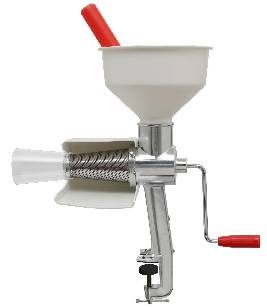
Food Mill

Mirro 50024 2-quart FOLEY Food Mill, Stainless Steel
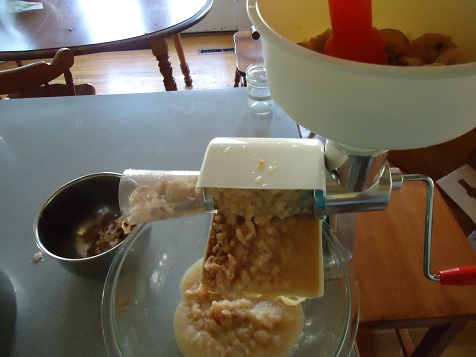
I usually make my applesauce in a blender, but if you prefer to leave your peelings on your apples…cook them down, then run them through a food mill like this one. I have one and while it takes quite a bit of muscle to get a big batch of applesauce made, it’s yummy!
Funnel

Norpro Stainless Steel Wide-Mouth Funnel
In my opinion, a wide mouth funnel is a must-have for canning. I use mine ALL THE TIME. I paid full price for mine through Azure Standard and it was well worth it. But, I wouldn’t mind a second (or third) one, so I’m keeping my eye out for them at garage sales.
Ziplock bags

Ziploc® Double Zipper Plastic Freezer Bags, Gallon (94604ZIP) Category: Plastic Ziplock Bags
Okay, you probably won’t find these at garage sales, but while we’re on the subject of saving money while you preserve food, I recommend stocking up on quart and gallon sized freezer bags when they’re on sale and when you have coupons. Two tips: Only use freezer bags for freezing produce. Regular storage bags won’t cut it. And…stick with name brand Ziplock bags for produce. I won’t tell you about the time I made real apple cider and froze it in generic freezer bags. Let’s just say everything in my freezer was sticky for six months and I lost a lot of my apple cider. :(
Have you found any great deals at garage sales and auctions for canning jars and etcetera? What else am I forgetting to mention that we should be looking out for at garage sales?
————————————————–
This post is linked to Frugal Fridays.
The Kitchen Overflowing With Fruit Whips Out Some Homemade Fruit Leather
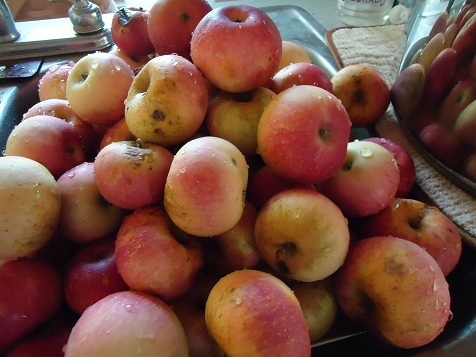
Posted by: | CommentsWhen you look at an apple tree and see that it is loaded with fruit…it’s all so very pretty and exciting. So you begin to pick the apples and load your boxes…and it gets even more pretty and exciting. And then you go overboard because all of it is all so pretty and exciting that you just can’t stop picking.
And then, you go home with all of your apples, and someone else calls you on the phone and asks if you want some more apples. And you say, sure, because you just hate to turn away good (free) food. So then, you have even more apples.
And then someone else calls you (in the same day) and asks if you want some peaches. Like FOUR banana boxes full of peaches. And you get really excited (forgetting briefly about all of the apples) and say, yes, you’d love to have all those peaches. (And then you share some of the peaches because really, four banana boxes full? Have you seen a banana box?)
And then you get started in your kitchen making applesauce and canning and freezing peaches…and you keep working until everything, including your children, begin to look like either an apple or a peach. Sad, but true.
You decide that you’re kind of tired of doing the very same things with your fruit, so you try to make some fruit leather. And it works, and it’s yummy. Everything and everyone around you still looks like an apple or a peach…but at least now, you have another kind of snack stored away in your pantry for the winter. Hooray!
Here’s what you would do…
Apple Fruit Leather
1. Make applesauce as shown here.
2. Put a piece of buttered parchment paper on a cookie sheet and spread the applesauce about 1/8 inch thickness on the cookie sheet.
3. Put it into a 170 degree oven for somewhere between 10-18 hours or longer, depending on your oven. Your fruit leather will be done with it is no longer wet….just sticky and leathery.
You can add some kind of sweetener to it or maybe some cinnamon or nutmeg if you’d like…I just left mine plain and it is sweet and yummy as can be!
Peach Fruit Leather (So Easy!!!)
1. Wash peaches
2. Cut them off of their pit and throw them, skin and all, into the blender.
3. Add a shot of water and puree them until there are no chunks.
4. Spread it onto a piece of buttered parchment paper on a cookie sheet, about 1/8 inch thick.
5. Put it into a 170 degree oven for somewhere between 10-18 hours or longer, depending on your oven. Your fruit leather will be done with it is no longer wet….just sticky and leathery.
***A few things to note about making the fruit leather.
*While you are making it you might think that it is taking FOREVER. And you’d be right. It does. Be patient.
*My fruit leather didn’t dry evenly in my oven…so sometimes I would cut off the sections that were dry (so that they wouldn’t get overdone), and stick the rest back in the oven. This meant I had some weird shaped fruit leather, but I was going to cut it all up to store it anyway, so it didn’t matter.
*I loved it that I could put this in the oven in the late evening, then I could go to sleep and have it be all done, or almost done, when I got up in the morning!
I let us all have a sample taste….then I put it into a jar and into the pantry (should be stored in a cool, dark place). Right now we have so many fresh fruits available to us that I’m sort of hoarding the food I’m preserving. I’ll pull out the fruit leather on some wintery day when fresh fruit is not so abundant! THEN it’ll really be a treat!
Okay, I’m off to go start peeling more apples… :)
[print_link]
Awesome Easy Tomato Soup
Posted by: | CommentsIt’s almost that time of year again… The time when we can warm up at lunch with a grilled cheese sandwich and a bowl of tomato soup!
I LOVE this recipe that was given to me by my friend Anne…who got it from her friend Anne. (Yeah, like that’s not ever confusing.) Along with canning lots of tomato sauce and tomato juice and salsa, I love canning several jars of Anne’s tomato soup for the winter! (Wait, which Anne is that?)
Most of the tomato soup you’ll find at the store will have high fructose corn syrup or sugar in it…
This recipe has no sugar…which is amazing because it tastes so yummy and sweet! Once when Matt was eating some, he asked at least three times, “This really doesn’t have any sugar in it?” :)
Homemade Tomato Soup
5 pounds chopped tomatoes
1 cup chopped onion
3 T. butter
1 1/2 t. sea salt
Put everything in a big pot and cook it for about 3 hours. Then, put it into your blender and blend until smooth. Freeze it, or can it following these canning methods.
I love having recipes like this that are so simple to make and healthy for my family!
Canning Tomato Juice and Tomato Sauce
Posted by: | CommentsOkay, we’ve covered the basics of canning…freezing corn…freezing green beans…canning and freezing peaches…making and canning applesauce…
Now lets talk about tomatoes!
Last year, I planted 40…yes FORTY tomato plants. On purpose. Because I’m crazy.
I ended up having SO MANY tomatoes, that by the end of the summer, I had canned almost two years worth of tomato sauce, tomato juice and tomato soup. And, I still had tomatoes! I was begging people to please come pick my tomatoes and take them far, far away from my house.
While canning that many tomatoes was a wonderful thing…I still hadn’t fully recovered from it when it came time to plant tomatoes this year. Therefore, I only planted 20 tomato plants this spring. *cough*
The good thing is…I never have to buy any tomato juice, sauce or soup. Ever. And the home-canned stuff is SO GOOD!!!
Here’s the way I make tomato juice and tomato sauce…
First, you start with bunches and bunches of pretty tomatoes, like these. You can take the skins off and the seeds out if you want to…I pretty much just WASH them. I leave the skin on and and the seeds in…mostly because I’m just too lazy to do otherwise. My family doesn’t know the difference, and you can’t really even tell that the seeds and skin are still there. At all.
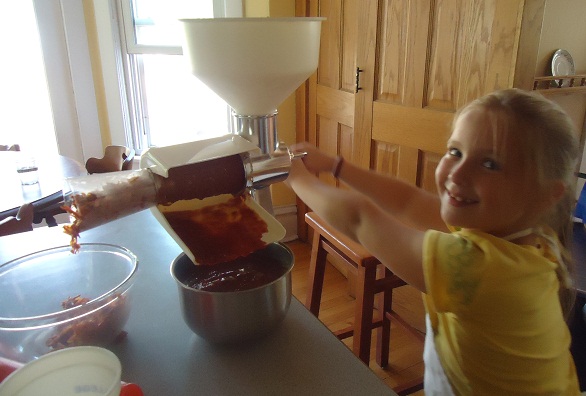
Next, I cut the tomatoes into fourths and put them into my blender.
The tomatoes are then blended up until they are liquid.
(Mmm, tomato smoothie anyone?)
After I blend up my tomatoes, they go into a big pot. Obviously this pot was not quite big enough! Filling your pot this full will just about guarantee that your pot will boil over and spill all over your stovetop creating a cooked on tomato mess. (Picture of the boiled over mess not available…because I scooped some out before it boiled over, thank you very much.)
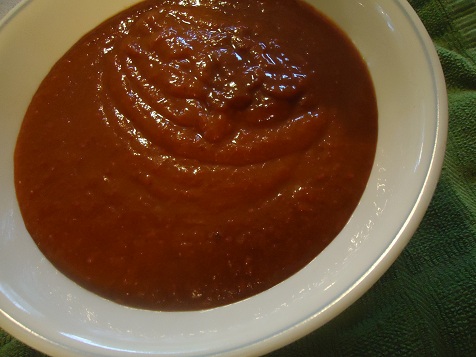
Next, I boil my tomatoes, uncovered, stirring occasionally. After a while it begins to look like this. Once that bubbly froth is just about all gone from the top (about an hour and a half or so after beginning the boiling process), you have made tomato juice, and you’re able to go ahead with the hot water bath process of canning tomato juice.
But, if you want tomato sauce, continue to let it boil for another hour or so. You’ll know your tomato sauce is done “saucing” when most of the watery liquid has evaporated. If you continue to cook it at this point, you will have tomato paste…which is fine…if you want tomato paste.
Can your tomato sauce for 25-30 minutes following the hot water bath instructions here.
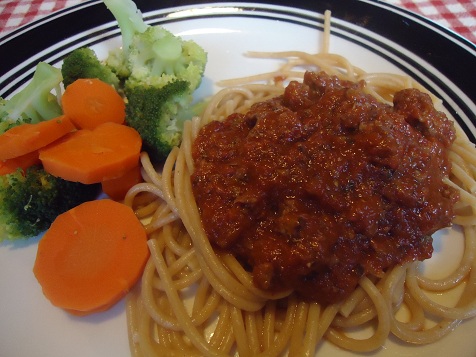
Then, you will have tomato juice for yummy veggie soups and such…and tomato sauce for sloppy joes, pizza sauce, spaghetti sauce, enchilada sauce…and whatever else you use tomato sauce for. (If you want to, you can add your herbs and spices into the sauce while your making it so that you’ve got your spaghetti and pizza sauce already put together in your jars!)
AND, if you’ve got other veggies laying around, like yellow squash or zucchini…throw those in while you’re blending up your tomatoes…and add them to your sauce before you cook it down. No one will ever know!
I have a wonderful recipe for tomato soup that I’ll be sure to share soon!
Yumm-eeee!
——————————————————-
You’ll find more Frugal Friday tips here.
How to Make and Can Applesauce
Posted by: | CommentsOne of the best “Fall smells” I can think of is applesauce cooking on the stove. It is SO YUMMY!!!
Here’s a step by step of the easiest way I’ve found to make applesauce. (But be sure to read Canning 101 first if you’re unfamiliar with the basic steps of canning safely!)
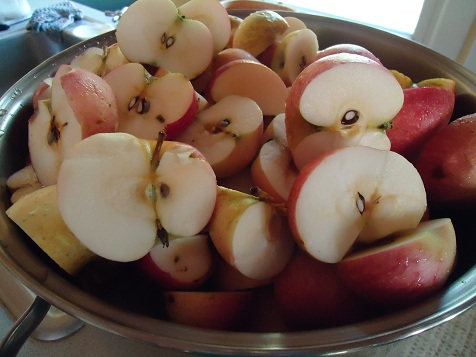
I slice my apples like this, then peel each slice.
I find this to be much easier than peeling the whole apple first and then slicing it.
As I slice and peel, I put my apples into a big pot. At the bottom of my pot is 5 cups of water and 3 teaspoons of ascorbic acid (powdered vitamin C).
As I continue to add apples, I stir them into the water/ascorbic acid frequently so that the apples are all coated with the mixture and are much less likely to turn brown.
Once I have my pot 3/4 full of apples, I put it on the stove…
and bring it to a boil, then simmer it (uncovered)
for about 30 minutes or until the apples are tender.
Then, I spoon the tender apples with some of the liquid into my blender
and blend it all up until it is smooth.
Isn’t it pretty!!! Next, I pour the applesauce
into sterilized jars with a wide mouth funnel.
I hot water bath my jars for about 25 minutes.
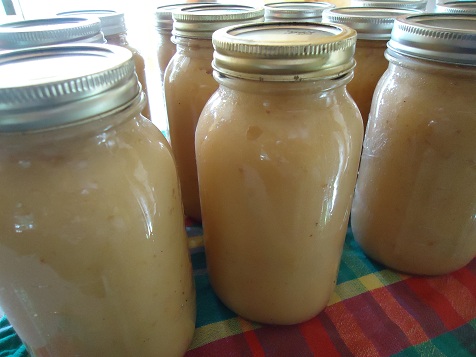
And like always, after I pull them out of the hot water, I set them on my counter for several hours (or days) so that I can admire them and feel happy about my applesauce. Ahh…..beautiful!
Freezing and Canning Peaches for Winter
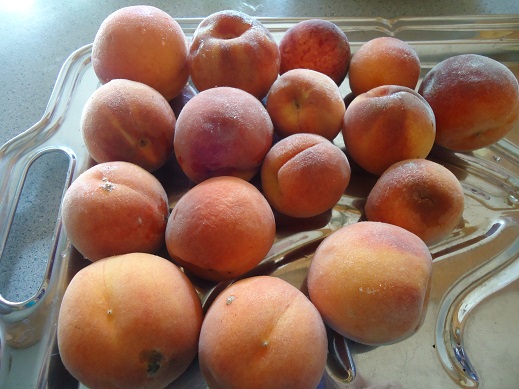
Posted by: | CommentsI mentioned that over the weekend I received millions and millions (okay, maybe not millions) of peaches from a lady in town. I’ve been busy preserving them for winter and thought I’d walk through the steps with you.
Please note: These peaches were so awesome and juicy, and since there were so many of them, I felt that none of us needed to hold back on how many we ate. So, as I was standing in my kitchen peeling and slicing peaches, and peach juice was running down my arms…I was also biting into peaches as I worked, because I just couldn’t resist. Therefore, I also had peach juice running down my chin. But with peach juice all over my hands and running down my arms, it’s not like I could do much about my chin, you know? Not one of my finer moments.
Thought you might like to picture that.
If you remember, I was given four boxes of peaches. (I did share a few with some friends.)
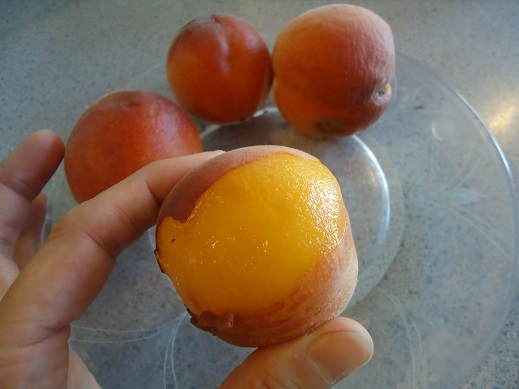
In the past, I’ve always peeled my peaches with a knife…and that’s been fine. But I had so many peaches this time, I went ahead and tried this method of peeling, and whoa was it a time saver! Just put your peaches into boiling water for about 30 seconds…pull them out…
And those skins just peel right off!! It was awesome. Except for when they didn’t peel right off, which happened with a few of them for some reason. (Just thought I’d tell you that so that if not all of them peel right off for you, you’ll know that you aren’t the only one!)
(You don’t have to peel your peaches if you’re going to freeze them. They’ll be more nutritious if you leave the peelings on, and it will save so much time too!)
To freeze peaches, just peel, slice and lay the peach slices on a cookie sheet lined with parchment paper. Put the pan into the freezer until the peaches are frozen, about two hours. (Or longer if you forget they’re in there.) Then put them into a freezer bag and you’ve got great peaches for smoothies and slushies!! And cobblers and crisps! (If you feel like skipping this step and simply just putting your peach slices directly into a pan without freezing them individually like this first, you can…but you’ll end up with one big gallon sized frozen peach-sicle, and you may be very frustrated when you want only part of the rock hard peach-sicle for a smoothie. Just so ya know.)
Now…to can peaches…this is what I do. There are other ways to do it…this is just the way I do it! Please be sure to go back and read Canning 101 for the canning basics!
I make a honey/water solution on my stove…which is 2 T. honey to every 5 cups of water. Heat it on the stove and let it sit warm while you prepare your peaches.
Take out a hot jar and put in about 1/16 teaspoon of ascorbic acid to keep your peaches pretty. Just dump it into the bottom of the jar. (Some people use lemon juice)
Ascorbic acid is powdered vitamin C. I get mine at a health food store.
Fill the jar with sliced peaches. Then, use a funnel to pour your honey/water into the jar, to about a half inch from the top. Place a sterilized lid and ring onto the full jar.
Now it’s time to give your full jars a hot water bath to seal the lids. Put your full jars into the water. Once the water is boiling, boil the jars for about 25 minutes. (And yes, this is actually a picture of applesauce jars boiling…I forgot to take a picture of the peaches boiling and I’m too tired to go can more peaches just so that I can go take a picture of the jars boiling.)
Oh, and boil your jars with the lid on the water bath pot…I just took off the lid for the picture. :)
After the jars have boiled for 25 minutes, take them out with tongs…or better yet, this cool gripping tool made especially for jars and hot water baths. Then you get to listen for the caps to seal. I can’t think of a way to blog the way it sounds…but after all your hard work, it sure is a cool sound to hear them seal! (Thhhhp!) (Or something like that!) You can be sure they sealed if you can push down on the top and it is down firm. It takes anywhere from 1 second to 30 minutes for the lid to seal after you’ve taken it out of the water.
Then, just leave your canned peaches out on the counter for a few hours or several days so that you can admire them and smile and feel happy every time you walk into the kitchen and see them. (Okay, that’s what I like to do anyway.) (Because I’m weird like that.)
Canning 101
Posted by: | CommentsJust in case you may be unfamiliar with the beautiful art of canning fruits and veggies…I thought I’d do this post to explain some of the basics. Then later, I can post about the specifics!
Here are some of the basic supplies you will need in order to can food. Some of these supplies are not entirely neccessary…just really, really helpful. Some of these supplies are entirely neccessary.
If you are planning on canning fruits or veggies, you will need jars.
(Oh, how I love jars!) I like having both quart and pint sized…
and my favorites are the wide mouth jars.
You’ll also need lids and rings. The rings you can re-use year after year,
but in order to have your lid seal, you must use new ones each year.
This handy dandy tool is a magnetic wand, which I use to retrieve lids
and rings out of hot sterilizing water. (See below) I love this tool!!
This tool helps me grip the jars as I pull them out of the hot water bath.
Since I’ve had this tool, I have broken fewer jars and burned myself less often.
I SO recommend one of these.
This wide mouth funnel is a lifesaver when you’re trying to get
your produce into the jar without making a big mess.
A water bath pot is pretty neccessary…
if you’re planning to seal your jars in a water bath.
Okay…next…
Here are a few things you need to know if you don’t want to die from botulism…
*Using the hot water bath system to seal your jars is only safe if you’re canning something acidic. Otherwise, food must be sealed in a pressure cooker. Food that I know of to be safe to can in a hot water bath: tomatoes, apples, peaches, pears. If you aren’t for sure what’s safe…please look it up to be sure before you use a hot water bath to seal your lids!
*You need to sterilize your jars, lids and rings before you put food into them. All I do is put my clean jars upside down into a shallow pan of boiling water for a couple of minutes.
I do the same with my lids and rings.
See, this is where that magnetic wand comes in very handy!
*When you put your jars full of yummy fruits or veggies into the hot water bath, I recommend putting them in before you start to boil the water. If your water is already boiling hot, you run the risk of breaking your jars and losing all of the work you put into filling. So, put your jars into the pot of water, then turn it on to begin to get hot. Once it finally starts to boil, then start your timer for the recommended boiling time.
Okay…this will all make more sense with my other posts about canning specific fruits and veggies. But…that gives you the basic information you’ll need so that those posts will make sense. Or maybe none of it makes any sense and you’d rather just come over and watch. (Watch, nothin’. I’d hand over a knife and some apples and tell you to get busy.) :)
Stay tuned…canning peaches and applesauce coming soon!
————————————————-
Find more kitchen tips on Tammy’s Recipes.
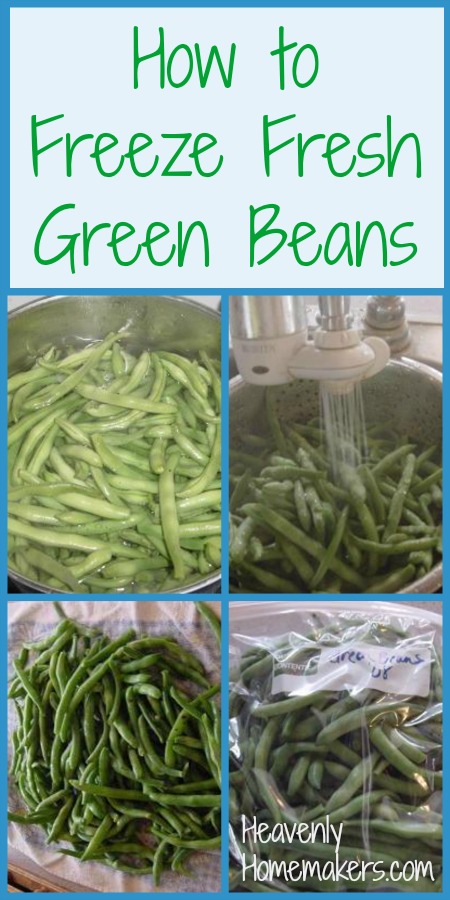
Putting up Green Beans for Winter
Posted by: | CommentsAfter posting about how I put up corn for winter, many of you asked about green beans. I just happen to be in the middle of crazy green bean season. So…here you go!!
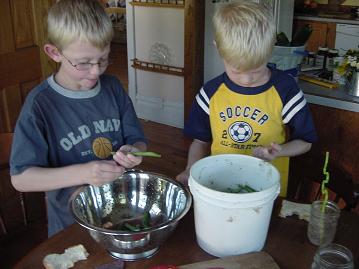
After picking our beans, I usually get my boys on “bean snapping duty” right away. (They never complain about this job. I think it’s because they are given permission to “break things”….what do you think?) They snap off the ends and put the green beans into a colander. As soon as the colander is full I wash the beans to try to get as much “garden” (my nice way of saying bugs and dirt) off.
It is my understanding that in order to maintain as much green bean nutrition as possible, it is best to only snap the ends off the bean…not to snap the bean into pieces. It makes sense that if you snap the green bean into three pieces, when you cook the bean, more of the nutrients will be washed away in the water. But if it’s a whole bean…more of the nutrients stay inside the bean. (And you can have “My green bean is longer than your green bean” competitions while you eat dinner.)
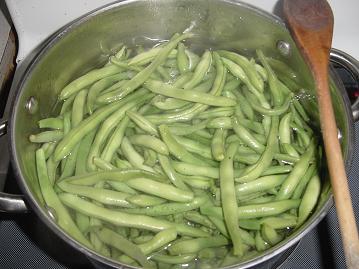
After washing the green beans, I then put them into a pot of boiling water. This blanching process stops their aging process. (No, you can not blanche people in order to stop their aging process.)
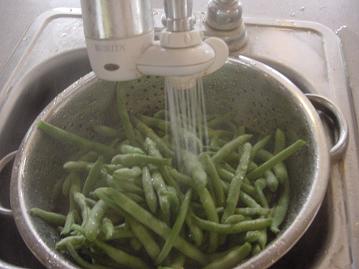
After about two minutes in the boiling water, the green beans are a brighter green…and they go back into the colander where they are given a cold, cold shower. This process stops the cooking process that the blanching part started.
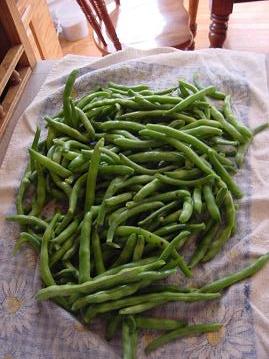
After the green beans are cooled from the cold water shower, I then spread them out onto a dry towel. I use another towel to pat over the top of them to help dry them off more. If your beans are too wet when you put them into a freezer bag, you’ll have ice form around your beans. (You don’t want ice to form around your beans.)
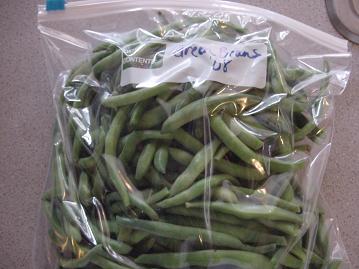
And then, I put my beans into a gallon freezer bag and label it. And into the freezer it goes. I know some people prefer to can their green beans. I don’t can them for two reasons:
1. Freezing them maintains more of the green bean’s nutrition.
2. I’m incredibly afraid of my pressure cooker. (When I got my mom’s pressure cooker, it didn’t have a manual with it. I have no idea how to use it properly.) I do not need to cause an explosion in my kitchen.
So there you go! As I begin to can and freeze my tomatoes and fruit for the winter, I’ll be sure to show you those processes too! (Yeah, because those don’t require a pressure cooker, just a hot water bath…and I’m not so afraid of those.)
Putting up Corn for Winter
Posted by: | CommentsNo. 1 thing to know about preserving produce for winter: It takes hard work and time and might make a big mess.
No. 2 thing to know about preserving produce for winter: In the winter when you get to pull yummy things out of your pantry and freezer…all the hard work and time and big mess will have been worth it. Very worth it!
Here’s a bit about how I put up corn…and you should also check out this post at Amy’s Finer Things because she blogged about this already. I really liked her technique for cutting the corn off the cob!
First…here is our happy little party of Nebraska Cornhuskers….
Check it out…they make a game of how far they can throw the husks. Hey, whatever it takes to get the work done with a happy attitude!
Meanwhile…I’m in the kitchen sticking those ears into boiling water. Just for a short time. Two to three minutes. Blanching stops the aging process of your produce.
Ah, but you don’t want them to continue to cook…so you immediately pull it out of the boiling water (with tongs of course) and run it under cold water to try to cool it off right away. (And Amy recomended putting it in ice water…a much better idea!!)
Now, I line up my ears (hehe…line up my ears…hehe)
And then I cut the corn off the cob into a bowl with a sharp knife. If you have an electric knife, you can use that too. Or do it the way Amy does it. (Oh, so many options.) (But no matter what option you choose, your hand will probably cramp up and feel like it will never again be them same by the time you’re done. But don’t worry, after several operations, you’ll be okay again.) (Kidding…just give yourself a few minutes of a hand massage.)
I then use a measuring cup to scoop the corn into freezer bags. Sometimes I use quart…sometimes I use gallon. Just don’t fill the bags too full, or after it freezes, you’ll have a terrible time getting your corn out of the bag!
Then get the air out of the bag and seal it up and press it flat. And it’s ready to go into the freezer. Isn’t it beautiful?
When you’re ready to cook it, break off whatever amount of corn you want, put it into a saucepan with a little water and cook it until it’s bubbly. Turn it off, drain out the excess water and stir in butter and salt!
Awesome!
I’ll show you to process of freezing green beans another time!